HISTORICAL RECORD
Historical Sources and Evidence
These sources provide historical context. They do not necessarily support the quantities or cooking times in the modern adaptation.
Registered as historically inspired. This does not establish that the dish or its methods reproduce historical practice.
Statements supported by sources
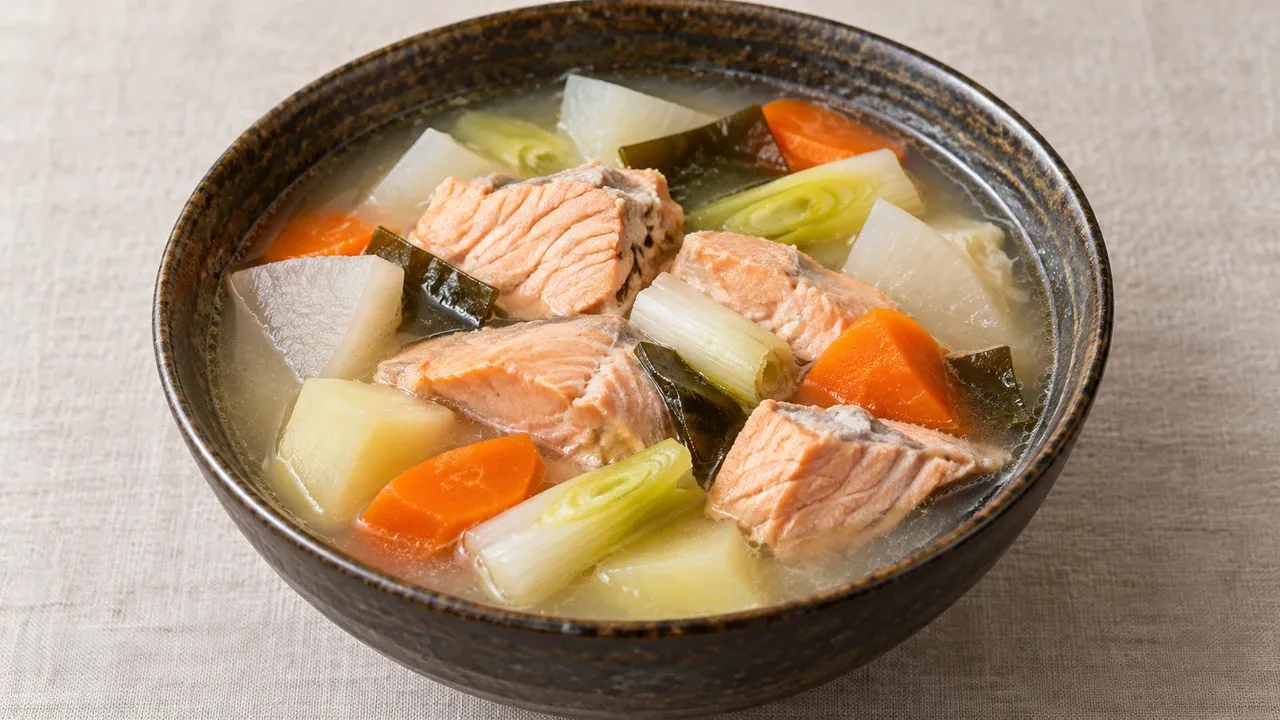
Japan's agriculture ministry describes ohaw as a substantial soup and calls fish versions cep ohaw.
The Hokkaido Museum's published home recipe from the former Ainu Museum includes salmon, kombu, root vegetables, long onion, salt and oil.
Inference and interpretation
- This salmon soup is not a single formula shared by every region or household. Cep refers to fish; the name itself does not restrict the dish to salmon, which is our choice here. The ministry also presents a miso-seasoned version.
Modern adjustments
- Use fresh salmon fillets rather than bony trimmings, organs or wild-foraged plants. Quantities, 900mL water, divided salt, cooking the potato earlier and timings are untested modern choices. Long onion appears in the museum recipe; it is not claimed to be identical to an ancient wild ingredient.
- The 75°C hold for at least 1 minute is the general cooking target adopted here; it does not remove bones or guarantee control of every hazard. Eating refrigerated leftovers within 24 hours is a cautious household choice, not a safety guarantee.
Sources and references
- Ainu Traditional Cuisine
- Author
- MAFF, Hokkaido District Agriculture Office
Open source: https://www.maff.go.jp/hokkaido/jigyou_shien/syokubunka/ainu-dentouryouri.htmlA modern institutional account was consulted; it is distinct from a historical recipe text.
- Ainu Traditional Cooking: Easy Recipe — cep ohaw
- Author
- Hokkaido Museum / former Ainu Museum, Shiraoi
Open source: https://www.hm.pref.hokkaido.lg.jp/wp-content/uploads/2025/02/9f144191091539ee5e83fe84b1abb899.pdfThe public PDF ingredients and method were read. This documents a modern practice, not a fixed nineteenth-century formula.
- At-home Ainu Cooking — Hokkaido Museum
- Author
- Hokkaido Museum
- Publication or composition year
- 2020 (material provided in 2015)
Open source: https://www.hm.pref.hokkaido.lg.jp/ouchi-museum/detail-10/A modern institutional account was consulted; it is distinct from a historical recipe text.
- Six Points for Preventing Food Poisoning at Home
- Author
- Ministry of Health, Labour and Welfare, Japan
Open source: https://www.mhlw.go.jp/topics/syokuchu/dl/point.pdfPublic home-food guidance was consulted; it does not validate this untested formulation or guarantee safety.
- Cold Food Storage Chart
- Author
- FoodSafety.gov
Open source: https://www.foodsafety.gov/food-safety-charts/cold-food-storage-chartsPublic home-food guidance was consulted; it does not validate this untested formulation or guarantee safety.