HISTORICAL RECORD
Historical Sources and Evidence
These sources provide historical context. They do not necessarily support the quantities or cooking times in the modern adaptation.
Statements supported by sources
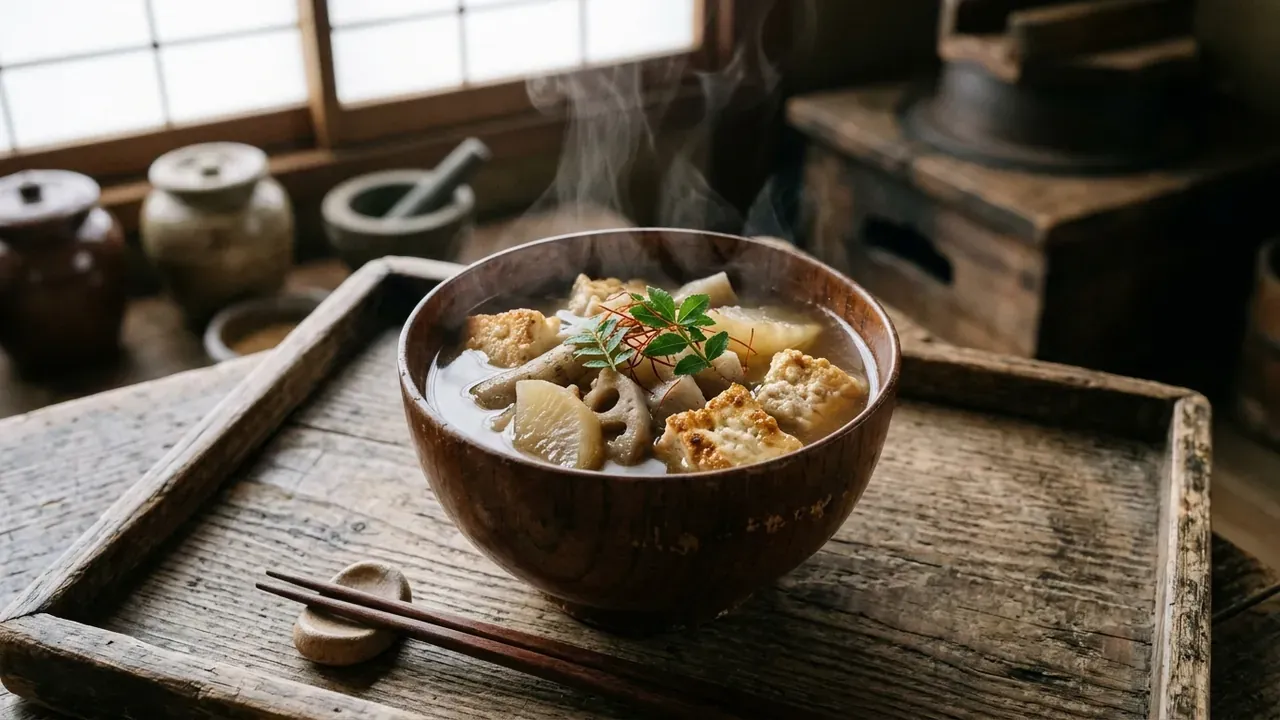
The 1643 Ryori Monogatari (Section IX, Soups) documents "Atsume-jiru", combining daikon, burdock, taro, tofu, bamboo shoots, skewered abalone, dried fugu, dried sea cucumber, and fish dumplings in mild miso or clear dashi broth.
Inference and interpretation
- Atsume-jiru in Ryori Monogatari is a soup combining many ingredients, including root vegetables and tofu. It shares some ingredients with later kenchin-jiru, but this passage alone does not establish a direct lineage or a process of fusion with Fucha cuisine.
- The 1643 text explicitly offers both "medium miso" and "clear soup" (sumashi) styles, demonstrating versatile seasoning traditions.
Modern adjustments
- While the 1643 primary text does not mention frying ingredients in oil, lightly stir-frying the root vegetables in sesame oil is a modern domestic adaptation to deepen fragrance and richness.
- Historical seafood items listed in the 1643 text (abalone, dried blowfish, fish ball dumplings) are omitted in favor of accessible seasonal root vegetables, tofu, and kombu-shiitake broth for a modest home table.
- Ingredients are simmered thoroughly until boiling hot; leftovers must be refrigerated promptly after cooling rather than left at room temperature.
Sources and references
- 料理物語
- Author
- 著者不詳
- Publication or composition year
- 寛永20年(1643年)
Open source: https://doi.org/10.20730/200021646Section IX (Soups) "Atsume-jiru" (Assorted Gathering Soup). Primary text states: "Mild miso with dashi is good, or make as clear soup. Good with daikon, burdock, taro, tofu, bamboo shoot, skewer abalone, dried fugu, dried sea cucumber, fish ball dumplings, and various others" (National Institute of Japanese Literature, 1643 edition, folio 12v, DOI:10.20730/200021646). Demonstrates rich early Edo soup culture blending assorted vegetables and tofu.