HISTORICAL RECORD
Historical Sources and Evidence
These sources provide historical context. They do not necessarily support the quantities or cooking times in the modern adaptation.
Statements supported by sources
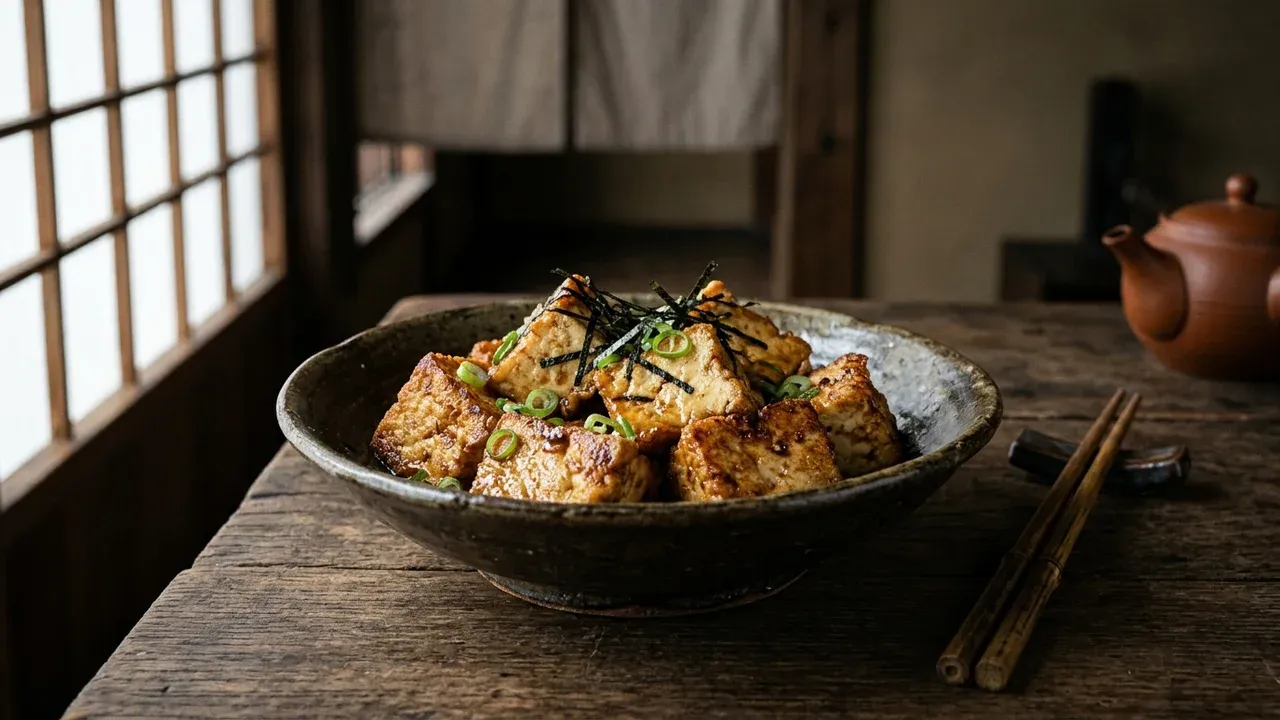
Tōfu Hyakuchin (1782, entry 10) records heating sesame oil, crushing tofu by hand into the pan, immediately adding soy sauce, and topping with scallions, grated daikon, or sansho.
The CODH catalogue dates the first and second parts of Shirōto Hōchō, compiled by Asano Kōzō, to 1803 and 1805. This is bibliographic evidence only, not verification of a kaminari tofu recipe in that book.
Inference and interpretation
- The dish is named kaminari (thunder) after the crackling roar produced when moist tofu hits hot sesame oil.
Modern adjustments
- Detailed draining and moderate heat are specified to prevent excessive oil splatters in domestic kitchens. Dashi and sake create a balanced modern glaze with nori garnish.
- Quantities and times are household design choices; this site has not cooked or shelf-life tested the recipe.
Sources and references
- 醒狂道人何必醇『豆腐百珍』尋常品 第十品「雷とうふ」
- Publication or composition year
- 天明2年(1782年刊)
Open source: https://d-archive.u-gakugei.ac.jp/en/item/tkgk-00132STEP281 checked the Tokyo Gakugei University catalogue and the image of entry 10, Kaminari tofu. Compiled by Kahitsu Jun, published in 1782. It describes adding crumbled tofu to hot sesame oil and immediately seasoning with soy sauce.
- 浅野高造輯『素人庖丁』初編(享和3年[1803])・二編(文化2年[1805])
- Publication or composition year
- 享和3年(1803年)・文化2年(1805年)
Open source: https://codh.rois.ac.jp/pmjt/book/200021953/Verified the Center for Open Data in the Humanities (CODH) and NIJL bibliography (compiled by Asano Kōzō), a key late Edo household cookbook.
- 厚生労働省:家庭でできる食中毒予防の6つのポイントOpen source: https://www.mhlw.go.jp/www1/houdou/0903/h0331-1.html
General guidance on 75°C for 1 minute, portioned cooling and refrigeration. The 4°C limit is our household handling choice, not a quotation of the source’s 10°C guidance.