← Back to recipes

A living food tradition; informed by documentation associated with Uzbekistan's 2016 UNESCO inscription

Central Asian Plov with Lamb and Carrots

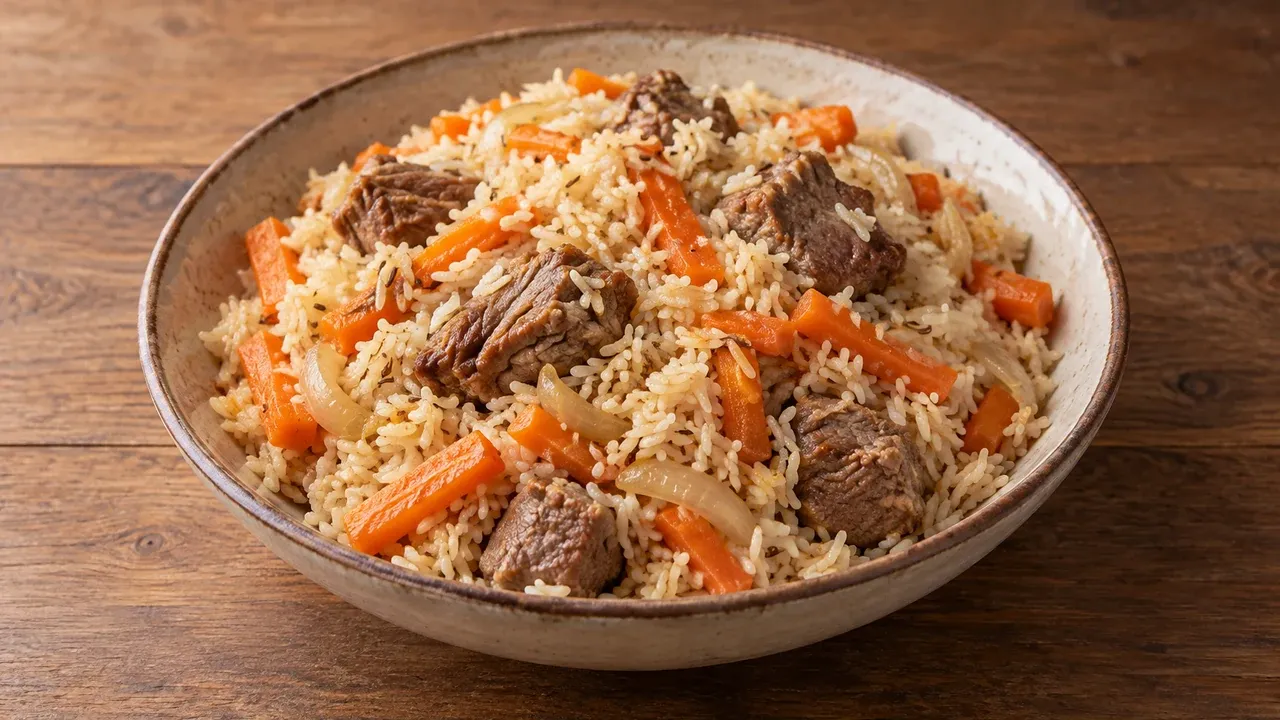
This proposal for 3 servings cooks rice over lamb, carrots and onions, with cumin. It adapts a Central Asian food tradition for a home kitchen in Japan. It is untested and does not reproduce a particular medieval formula.

AI-generated modern home-recreation image of long-grain plov with lamb, carrots and onions served in a bowl.

MODERN RECREATION

Modern Adaptation Proposal

Ingredient quantities, cooking times, and tools are proposed for modern home cooking. They are not measurements from the historical source.

Ingredients

Instructions

  1. Rinse the rice, soak in extra water for 20 minutes, then drain. Cut the lamb into 3cm cubes, the carrots into thin sticks and the onion into slices. Use a heavy lidded pot about 20cm across, holding at least 2L.
  2. Heat the oil over medium heat and brown the lamb's surface. Add the onion, carrots and cumin; cook until the onion softens.
  3. Add 250mL water and the salt. Bring to a boil, reduce the heat and simmer with the lid slightly ajar for 20–25 minutes. Check the centre of the thickest meat piece with a thermometer: it should remain at 75°C or above for at least 1 minute. Continue cooking if needed.
  4. Spread the rice over the meat and vegetables and add 150mL water. Without stirring it into the lower layer, return to a boil, cover and cook over low heat for 15–20 minutes.
  5. Check the rice. If it is still firm in the centre and the pot has dried out, add water in 30–50mL increments and cook longer. Turn off the heat, rest covered for 10 minutes, then fold gently from the bottom and serve. Allow about 90–110 minutes overall.
  6. Portion leftovers promptly rather than leaving them in the pot to cool; refrigerate ideally within 1 hour. Keep at 4°C or below and eat within 24 hours. Reheat only once, until hot throughout. Reheating does not rescue poorly stored food. Check lamb and processed-product ingredient and allergen labels.

HISTORICAL RECORD

Historical Sources and Evidence

These sources provide historical context. They do not necessarily support the quantities or cooking times in the modern adaptation.

Registered as historically inspired. This does not establish that the dish or its methods reproduce historical practice.

Statements supported by sources

  • UNESCO describes palov as a dish made with rice, meat, spices and vegetables.

  • The same account links it with everyday eating and social occasions such as hospitality.

Inference and interpretation

  • This cultural account does not establish that the modern formulation existed in the tenth or thirteenth century. No identity with a specific recipe by Ibn Sina or al-Baghdadi is claimed here.

Modern adjustments

  • Basmati rice, readily available carrots and lamb, and a domestic pot are modern choices. All quantities, heat settings, divided water additions and timings are untested proposals; rice, cookware and heat affect water needs.
  • Holding the meat at 75°C for at least 1 minute is the general household cooking target adopted here, not a guarantee against every hazard. Cool rice promptly and reheat only once. The absence of added wheat, eggs, milk or soy does not guarantee an allergen-free dish.

Sources and references

  1. UNESCO — Palov Culture and TraditionOpen source: https://www.unesco.org/archives/multimedia/document-4373

    The UNESCO description and metadata were consulted; medieval texts and the filmed cooking demonstration were not examined.

  2. Six Points for Preventing Food Poisoning at HomeOpen source: https://www.mhlw.go.jp/topics/syokuchu/dl/point.pdf

    Public home-food guidance was consulted; it does not validate this untested formulation or guarantee safety.
  3. Home Food Fact Checker — RiceOpen source: https://www.gov.uk/government/publications/home-food-fact-checker/home-food-fact-checker

    Public home-food guidance was consulted; it does not validate this untested formulation or guarantee safety.
  4. Cold Food Storage ChartOpen source: https://www.foodsafety.gov/food-safety-charts/cold-food-storage-charts

    Public home-food guidance was consulted; it does not validate this untested formulation or guarantee safety.
About this site

About our dish images
Image credits and sources

© History Meshi / Codex (OpenAI built-in image generation, STEP 227)

Source: AI生成による現代再現イメージ。実調理写真・史料写真ではありません。 / AI-generated modern recreation; not a cooking-trial or historical-source photograph. / AI生成的现代再现示意图,并非实际试做或历史资料照片。 / AI生成的現代再現示意圖,並非實際試做或歷史資料照片。 / Recreación moderna generada por IA; no es una fotografía de una prueba de cocina ni de una fuente histórica.

License: 再利用の許諾条件は未設定。 / No separate reuse licence specified. / 未设定再利用许可。 / 未設定再利用授權。 / No se especifica licencia de reutilización.