1891 publication (Cape domestic cookery)
1891 Cape Bobotee
A traditional baked minced meat dish of Cape domestic cookery, recorded in Hildagonda Duckitt's 1891 household cookery book published in London. Minced beef mixed with curry powder, sautéed onions, and milk-soaked bread is topped with an egg-and-milk custard, baked in the oven until golden, and served with rice in this untested home recreation proposal.
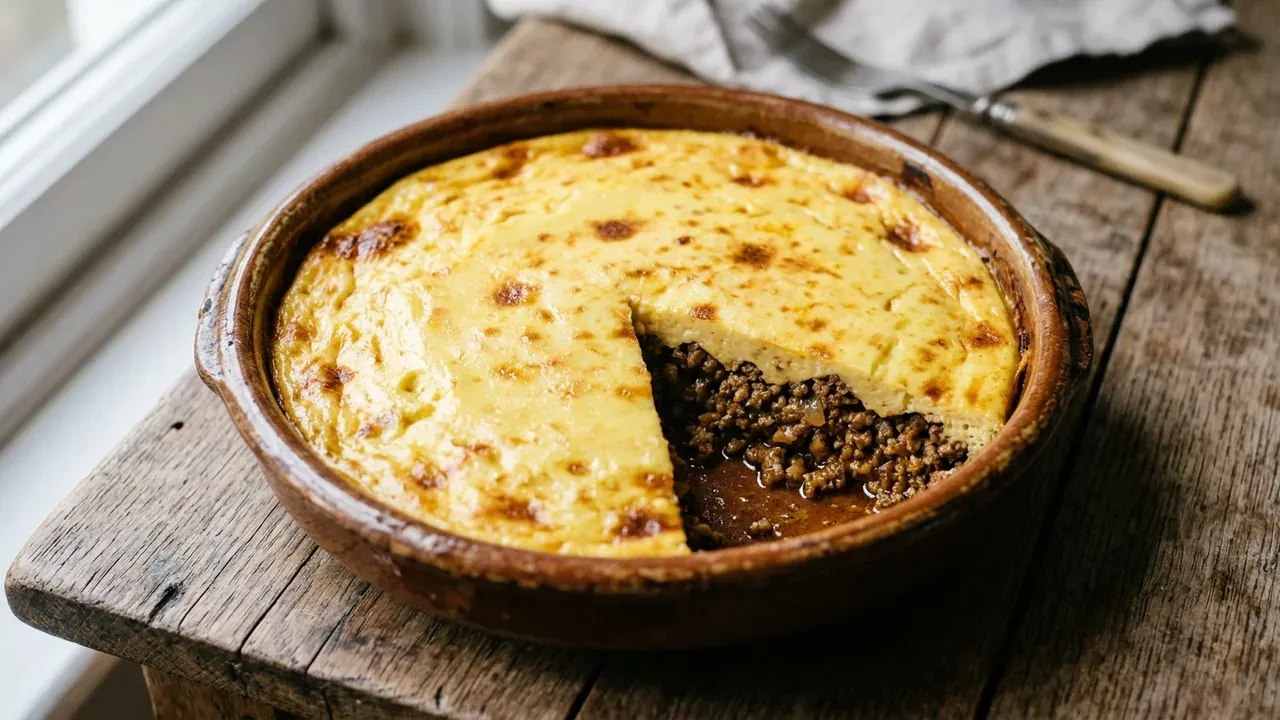
MODERN RECREATION
Modern Adaptation Proposal
Ingredients
Instructions
- 【Soaking the Bread】Place torn crustless white bread (30g) in a bowl, pour in 60mL of milk to saturate thoroughly, and gently squeeze out excess liquid with your hands (the squeezed milk may be reserved for the topping).
- 【Sautéing the Onions】Melt about 8g of butter in a frying pan over medium heat and sauté finely chopped onion until soft and translucent. Lower the heat, stir in curry powder, sugar, salt, and lemon juice until fragrant, then remove from heat and let cool slightly.
- 【Mixing the Meat Mixture】Wash hands and utensils thoroughly before handling raw meat and eggs. In a clean bowl, combine minced beef, squeezed bread, sautéed spiced onions, chopped almonds, and 1 beaten egg. Mix thoroughly and promptly until evenly blended. Never taste raw minced meat or raw egg mixtures to prevent foodborne illness.
- 【Arranging in the Dish】Lightly grease a shallow baking dish (approx. 1L capacity) with the remaining 2g of butter, spread the meat mixture evenly, and smooth the top with the back of a spoon.
- 【Pouring the Custard Topping】Beat the second egg with 90mL of milk in a bowl with a whisk until smooth. Gently pour the mixture over the meat layer, and stick 1 bay leaf into the center.
- 【Baking and Safety Verification】Bake in an oven preheated to 180°C (350°F) for approx. 25–35 minutes until the custard layer is puffed and golden brown, and verify with a food thermometer that the thickest part of the core reaches at least 75°C (167°F) for 1 minute. Do not rely solely on cooking time or visual appearance; if the internal temperature is insufficient, return to the oven and test again. Beware of severe burns from the hot oven, baking dish, and steam.
- 【Serving, Storage, and Safety Precautions】Carefully carry the baking dish to the table and serve warm portions alongside cooked white rice. The bay leaf is stiff and indigestible, presenting a choking hazard; always remove and discard it before or while serving. Note: Contains wheat, eggs, milk, almonds (tree nuts), and beef; verify commercial curry powder ingredient labels. Do not leave leftovers at room temperature; divide into clean, shallow containers, refrigerate at 4°C (40°F) or below within 2 hours (or within 1 hour if above 32°C / 90°F), and consume within 2 days after reheating to at least 75°C (167°F).
HISTORICAL RECORD
Historical Sources and Evidence
These sources provide historical context. They do not necessarily support the quantities or cooking times in the modern adaptation.
Statements supported by sources
Detailed ingredients and instructions are recorded under the heading 'BOBOTEE. (A delicate Indian minced curry. Malay or Indian. My mother's Recipe.)' on printed pages 12–13 of Hildagonda J. Duckitt's 'Hilda's "Where Is It?" of Recipes', published in London in 1891.
The 1891 recipe specifies 2 lb. of meat, 2 onions, a large slice of white bread, 1 cup of milk, 2 eggs, 2 tablespoons of curry powder, a dessertspoon of sugar, juice of a lemon or 2 tablespoons of vinegar, 6 or 8 almonds, and a lump of butter.
The method directs soaking bread in milk and squeezing dry, frying onions in butter, mixing spices and fried onion with meat, bread, and one egg, placing into a buttered pie-dish or little cups, pouring the second egg whisked with milk over the top, sticking in a lemon or bay leaf, baking in the oven, and serving with rice.
A historical note states that the dish is equally good made of cold mutton, and that the strained juice of 1 oz. of tamarinds soaked in half a pint of boiling water may be used instead of vinegar for a pleasant acid flavour.
Inference and interpretation
- While bobotie is widely discussed as having developed at the Cape through the blending of Southeast Asian and Indian Ocean spice traditions with European colonial domestic cookery under VOC rule, there is no direct evidence that the specific 1891 recipe formulation existed in identical form since the 17th century.
- Duckitt's descriptive subtitle 'Malay or Indian' reflected 19th-century colonial terminology for Eastern-influenced spiced dishes rather than an exact ethnographic proof of origin. Likewise, 'My mother's Recipe' was the author's subtitle and does not provide historical documentation of how many generations the recipe had been transmitted.
- The term 'Meat' in the 1891 text encompassed mutton and beef common at the Cape, without mandating any single species. The note referring to 'cold mutton' indicates re-purposing cold leftover cooked roast mutton. Minced beef is selected here for domestic consistency and accessibility.
- Regarding the '6 or 8 almonds', the historical text provides no explicit instructions for blanching or grinding; flaked or chopped almonds are customary in modern adaptations.
- Unlike 20th-century and contemporary bobotie recipes that feature generous amounts of raisins, sultanas, apricot jam, or chutney, Duckitt's 1891 recipe relies solely on a small measure of sugar and lemon juice (or vinegar) without added dried fruits or chutneys.
Modern adjustments
- Independently scaled down as an untested domestic proposal for about 3 servings based on 300g of minced beef, rather than a strict mathematical division of the historical 2 lb. of meat.
- Set at 10mL of lemon juice (approx. 2 tsp) as an independent domestic measure for 300g of meat, distinct from the historical whole lemon.
- Adapted the historical option of a pie-dish or individual little cups to a standard modern shallow 1-liter baking dish, with an estimated oven baking temperature of 180°C (350°F) for 25–35 minutes.
- Incorporated modern public food safety standards requiring verification that the thickest core reaches at least 75°C (167°F) for 1 minute using a food thermometer.
- Added an explicit safety instruction to discard the stiff decorative bay leaf prior to eating to prevent choking or injury.
Sources and references
- Hilda's "Where Is It?" of Recipes (BOBOTEE)Open source: https://archive.org/details/b28108486
Consulted the recipe 'BOBOTEE. (A delicate Indian minced curry. Malay or Indian. My mother's Recipe.)' on printed pages 12–13 of Hildagonda J. Duckitt's 'Hilda's "Where Is It?" of Recipes' published in London in 1891 by Chapman and Hall (Wellcome Library collection, Internet Archive edition). The historical text specifies 2 lb. of meat, 2 onions, a large slice of white bread soaked in 1 cup of milk, 2 eggs, 2 tablespoons of curry powder, a dessertspoon of sugar, juice of a lemon or 2 tablespoons of vinegar, 6 or 8 almonds, and butter. It instructs mixing the soaked bread, meat, and fried onion with spices and one egg, transferring to a buttered pie-dish or little cups, pouring the second egg whisked with milk over the top, sticking in a lemon or bay leaf, baking in the oven, and serving with rice. The high-resolution facsimile page images (leaves n25 and n26) on Internet Archive were directly inspected and verified.
- 厚生労働省「家庭でできる食中毒予防の6つのポイント」Open source: https://www.mhlw.go.jp/topics/syokuchu/dl/point.pdf
Consulted for official domestic food safety principles: thorough cooking of minced meat and egg mixtures (reaching an internal core temperature of at least 75°C for 1 minute), washing and sanitizing hands and utensils, preventing cross-contamination, timely consumption, and avoiding room-temperature standing.
- USDA FSIS「Ground Beef and Food Safety」食品安全指針Open source: https://www.fsis.usda.gov/food-safety/safe-food-handling-and-preparation/meat/ground-beef-and-food-safety
Consulted for official food safety guidance on minced meat dishes: using a food thermometer to verify a safe internal temperature (at least 160°F / 71.1°C for ground beef), never tasting raw ground meat mixtures, and refrigerating leftovers within 2 hours.
Image credits and sources
© History Meshi (AI-generated recreation image / AIによる再現イメージ)
Source: Modern adaptation concept based on Hildagonda J. Duckitt's Hilda's "Where Is It?" of Recipes (1891, pp. 12–13) / ヒルダゴンダ・J・ダキット『Hilda's "Where Is It?" of Recipes』(1891年)に基づく再現イメージ
License: Original site asset (not an actual cooking or historical source photograph / 実際の調理・史料写真ではありません)