← Back to recipes

Roman Vesuvian region, AD 79

Pompeii-style bread (Panis Quadratus, modern proposal)

A wholemeal and bread-flour loaf inspired by carbonised bread from the Pompeii area. This untested home-oven proposal is neither an edible archaeological object nor an exact reconstruction of one specimen.

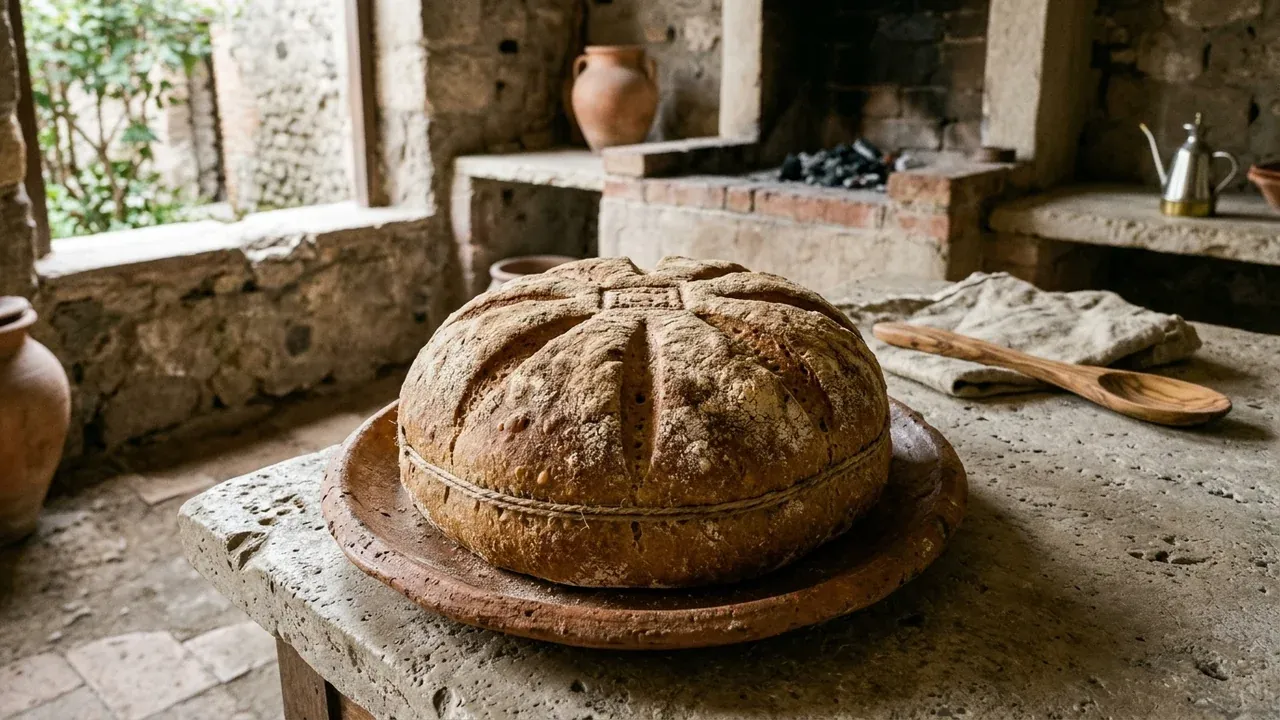
AI-generated modern recreation of a round segmented loaf with side twine and a central mark, not the carbonised artefact; shape, mark and setting are interpretive.

MODERN RECREATION

Modern Adaptation Proposal

Ingredient quantities, cooking times, and tools are proposed for modern home cooking. They are not measurements from the historical source.

Ingredients

Instructions

  1. Mix the flours and salt. Dissolve the yeast in 260mL lukewarm water and mix into the flour; add the remaining water gradually if needed to bring the dough together.
  2. Knead for 8–10 minutes, round and cover. Leave near 25°C for 60–90 minutes, until roughly doubled.
  3. Gently deflate and form a round 18–20cm across. Tie cooking twine once around the side without constricting it tightly, and trim the ends.
  4. Place on a baking sheet. Make four shallow cuts through the centre to mark eight sections. Make a slight central indentation, cover and prove for 30–40 minutes. A stamp is optional and unnecessary.
  5. Bake in a preheated 220°C oven for about 35–40 minutes. Look for a deeply browned crust and a hollow sound underneath; return to the oven if the cut centre remains doughy. Around 95°C at the centre is an optional baking guide, not a sanitation guarantee. Cool on a rack and cut away all cooking twine before slicing.

HISTORICAL RECORD

Historical Sources and Evidence

These sources provide historical context. They do not necessarily support the quantities or cooking times in the modern adaptation.

Registered as a reconstruction based on sources. Distinguish the source's account from inference and modern adjustments.

Statements supported by sources

  • The Pompeii archaeological park’s exhibition guide describes a carbonised loaf found inside a building.

Inference and interpretation

  • Segmented loaves and a perimeter groove inspire the shape, but the groove’s purpose and when any cord was applied are uncertain. Central marks were not a universal specification; the image’s mark is illustrative.
  • The manuscript’s museum number, Celer stamp and findspot have not been matched independently and are not asserted here. The proposal is not to eat a carbonised artefact.

Modern adjustments

  • The 400g flour mixture, yeast, water, timings, oven and twine shaping are modern choices, not a precise ancient formula or a recipe established from Pliny. Additional steam or a water tray is not required.
  • Untested and not tasted. One loaf is proposed; timing, yield and texture have not been verified.
  • Contains wheat. Do not eat raw flour or dough; bake through the centre. Avoid burns from the tray and remove every piece of shaping twine before eating.

Sources and references

  1. Parco archeologico di Pompei: Antiquarium, Room I — Carbonised BreadOpen source: https://pompeiisites.org/en/boscoreale-en/antiquarium-sala-i/

    Official exhibition description checked; it is not a recipe. Inventory 84595 and the stamped specimen have not been matched.

  2. CDC: Raw Flour and DoughOpen source: https://www.cdc.gov/food-safety/foods/no-raw-dough.html

    General advice against eating raw flour or dough and for thorough cooking; it does not prescribe 95°C for this bread.
About this site

About our dish images
Image credits and sources

© AI-generated for History Meshi (STEP199 production record)

Source: AIによる現代再現イメージ。実際の調理・史料写真ではありません。 / AI-generated modern recreation, not an actual cooking or archival photograph. / AI现代复原示意图,并非实际烹饪或史料照片。 / AI現代復原示意圖,並非實際烹飪或史料照片。 / Recreación moderna con IA, no una fotografía de cocina real ni de archivo.

License: 再利用の許諾条件は未設定。 / Reuse permission is not specified. / 未设定再利用许可。 / 未設定再利用許可。 / No se han establecido permisos de reutilización.