HISTORICAL RECORD
Historical Sources and Evidence
These sources provide historical context. They do not necessarily support the quantities or cooking times in the modern adaptation.
Registered as historically inspired. This does not establish that the dish or its methods reproduce historical practice.
Statements supported by sources
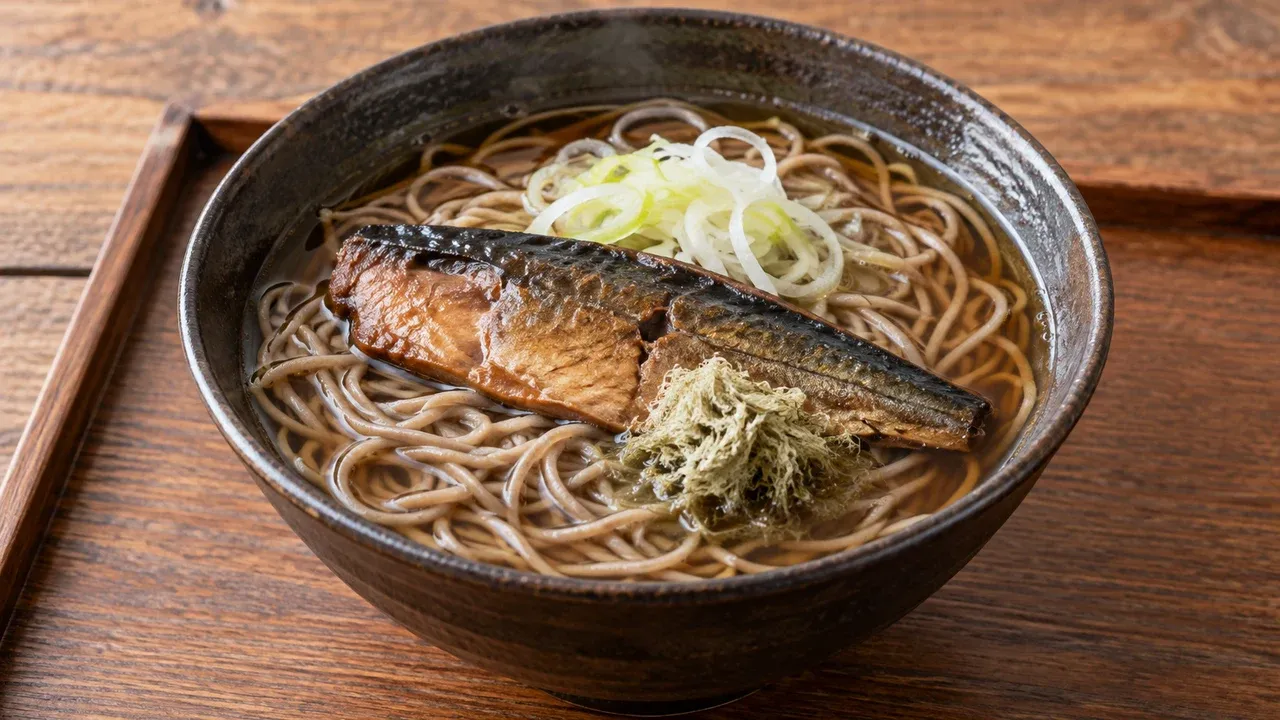
MAFF describes a Hokkaido dish of soba topped with sweet-simmered dried herring and discusses the herring fishery and Kitamaebune trade.
Nishin soba appears in Volume 2, Chapter 15 ("Smell") of Satoru Noda's manga Golden Kamuy, where Saichi Sugimoto eats it at an Otaru soba restaurant; it is also featured in Shueisha’s official food guide.
Inference and interpretation
- The public record describes regional origin traditions without establishing an invention year.
Modern adjustments
- This version uses ready-cooked herring and our broth proportions. Soaking and cooking dried fish are omitted; no historical keeping quality is claimed.
- Quantities and times are household design choices; this site has not cooked or shelf-life tested the recipe.
Sources and references
- 農林水産省「うちの郷土料理」ニシン蕎麦/北海道Open source: https://www.maff.go.jp/j/keikaku/syokubunka/k_ryouri/search_menu/menu/nishinsoba_hokkaido.html
Read the public account of history, ingredients and preparation. This is a modern heritage record, not a historical original edition; the date of origin is not established.
- 野田サトル『ゴールデンカムイ』第2巻・第15話「におい」/集英社公式料理案内Open source: https://youngjump.jp/goldenkamuy/contents/gourmet_chart/chart_end22.html
Referenced the scene in Volume 2, Chapter 15 ("Smell") set in an Otaru soba shop, along with Shueisha’s official food guide.
- 厚生労働省:家庭でできる食中毒予防の6つのポイントOpen source: https://www.mhlw.go.jp/www1/houdou/0903/h0331-1.html
General guidance on 75°C for 1 minute, portioned cooling and refrigeration. The 4°C limit is our household handling choice, not a quotation of the source’s 10°C guidance.