HISTORICAL RECORD
Historical Sources and Evidence
These sources provide historical context. They do not necessarily support the quantities or cooking times in the modern adaptation.
Statements supported by sources
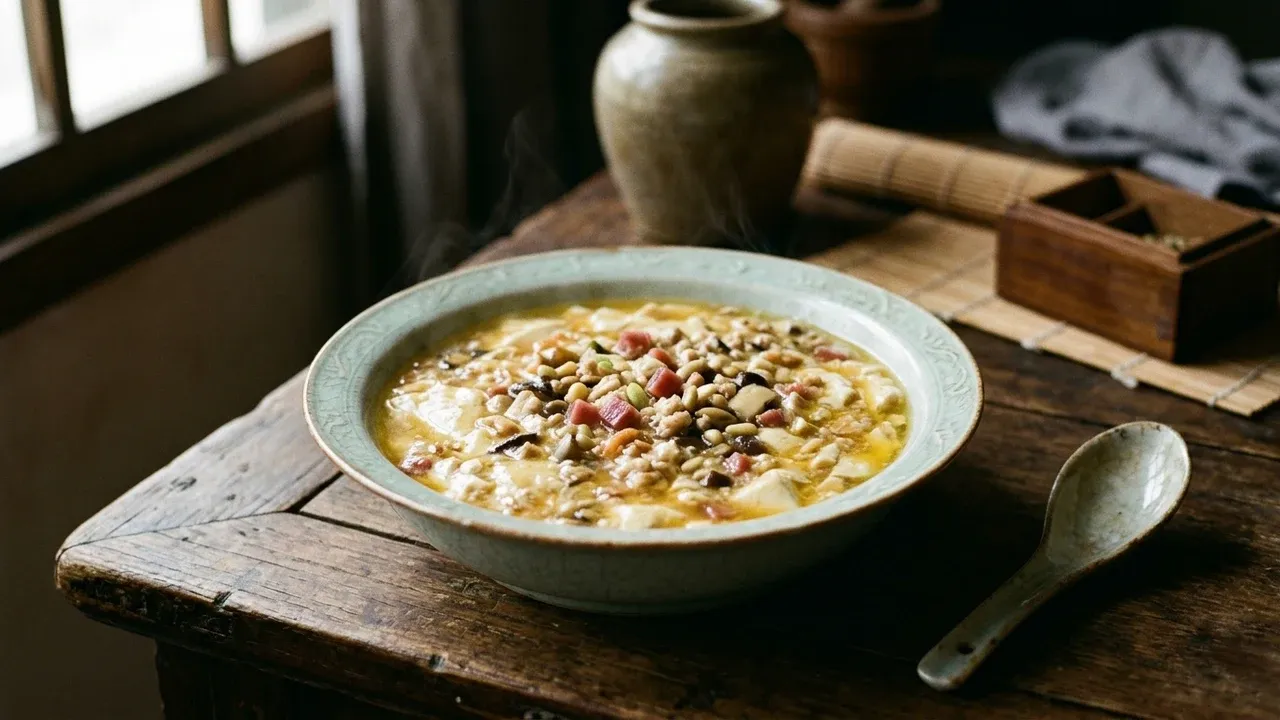
Yuan Mei's Suiyuan Shidan (1792 preface), Zasucaidan, describes finely cut nenpian, minced xiangxun and mogu mushrooms, pine and melon seed kernels, chicken, and ham, cooked together in concentrated chicken broth; soft tofu curds may also be used.
Inference and interpretation
- The text records Prefect Wang's account that Emperor Kangxi bestowed the recipe upon Minister Xu Jian'an and that Wang's ancestor, Mr Loucun, obtained it as Xu's pupil. This is a reported origin story. The heading and the option of using soft tofu curds support interpreting 'nenpian' as tender tofu.
Modern adjustments
- Modern selections are dried shiitake, button mushrooms, Jinhua ham (or unsmoked cured pork ham), and pre-cooked chicken breast.
- Pumpkin seeds are used as an accessible modern substitute for traditional melon seeds.
- Shelled pine nuts and pumpkin seeds are coarsely chopped, retaining some texture as a modern adjustment to the historical fine crumbs.
- Pre-stir-frying in cooking oil, Shaoxing wine, white pepper, and optional potato starch slurry are modern additions for kitchen convenience and warmth.
- Internal temperature standard of 75°C (167°F) for at least 1 minute is strictly specified.
Sources and references
- Suiyuan Shidan (隨園食單)
- Author
- Yuan Mei (袁枚 / 1716–1798)
- Publication or composition year
- 1792
Open source: https://zh.wikisource.org/wiki/隨園食單/第四節Yuan Mei's Suiyuan Shidan (1792 preface), Zasucaidan, 'Wang Taishou Babao Doufu', consulted in the public Wikisource text. Nenpian and minced xiangxun, mogu, pine and melon seed kernels, chicken, and ham are cooked together in rich chicken broth; soft tofu curds are an alternative. Specific mushroom species, ham, and melon seeds are modern selections. The underlying printed edition has not been identified.