HISTORICAL RECORD
Historical Sources and Evidence
These sources provide historical context. They do not necessarily support the quantities or cooking times in the modern adaptation.
Statements supported by sources
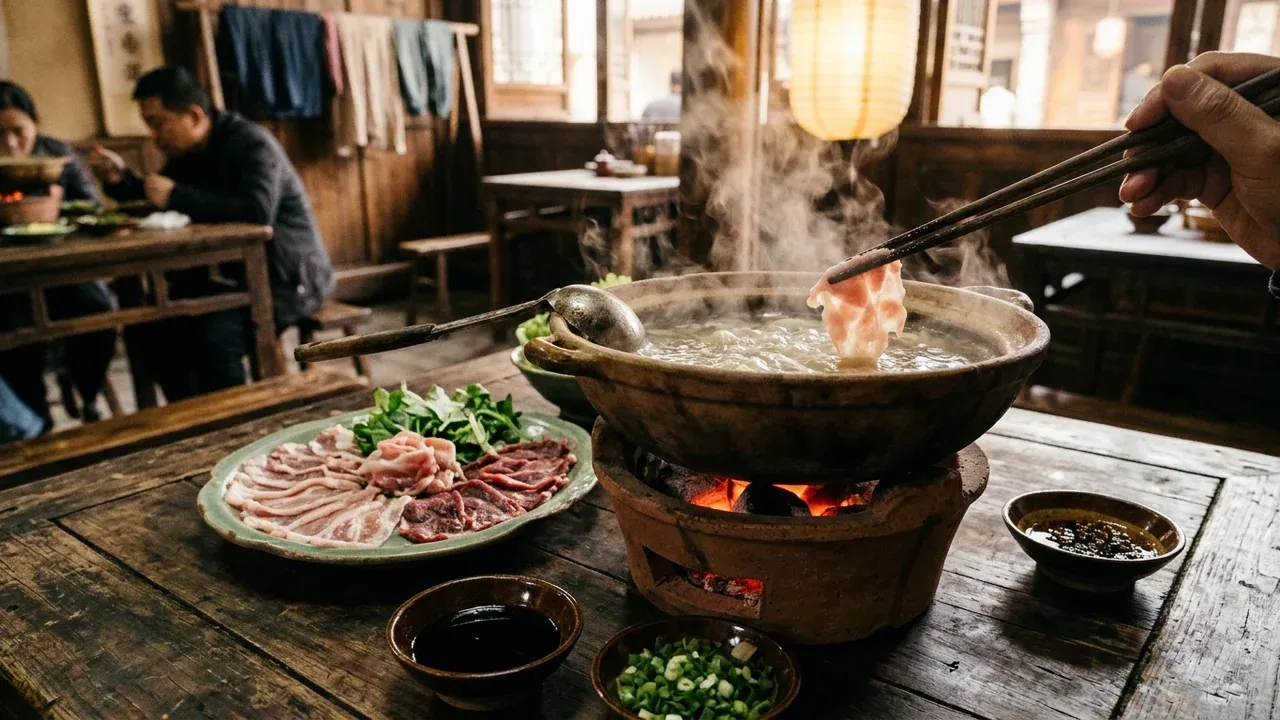
In Shanjia Qinggong, Lin Hong recorded that in the snowy Wuyi Mountains, thinly sliced meat was seasoned with wine, soy, and Sichuan pepper, then swirled in boiling water over a tabletop brazier, resembling sunset clouds dancing over waves ('浪湧晴江雪,風飜晚照霞'). He added that pork or mutton works equally well.
Inference and interpretation
- This stands as one of the earliest documented forms of tabletop communal hotpot dining in Chinese culinary history, reflecting literati gastronomic culture.
Modern adjustments
- To satisfy public health guidelines (holding internal core temperature at or above 75°C / 167°F for at least 1 minute), the modern basic recipe cooks a measurable piece of meat before slicing thinly, contrasting with the historical raw-tabletop method.
- Visual color checks and unscientific time-only claims are replaced by mandatory probe thermometer verification.
- Readily available pork is used following Lin Hong's note that pork or mutton is equally suitable.
- Complete separation of raw-meat tools and cooked-meat utensils is strictly required.
Sources and references
- Shanjia Qinggong (山家清供)
- Author
- Lin Hong (林洪 / 13th c.)
- Publication or composition year
- 13th c.
Open source: https://zh.wikisource.org/wiki/山家清供From Shanjia Qinggong (13th century) by Southern Song literatus Lin Hong. On a snowy day in the Wuyi Mountains, thinly sliced marinated meat was swirled in boiling water over a brazier and eaten with a seasoned dip ('浪湧晴江雪,風飜晚照霞'). Lin Hong explicitly noted that pork or mutton is equally suitable.