HISTORICAL RECORD
Historical Sources and Evidence
These sources provide historical context. They do not necessarily support the quantities or cooking times in the modern adaptation.
Registered as historically inspired. This does not establish that the dish or its methods reproduce historical practice.
Statements supported by sources
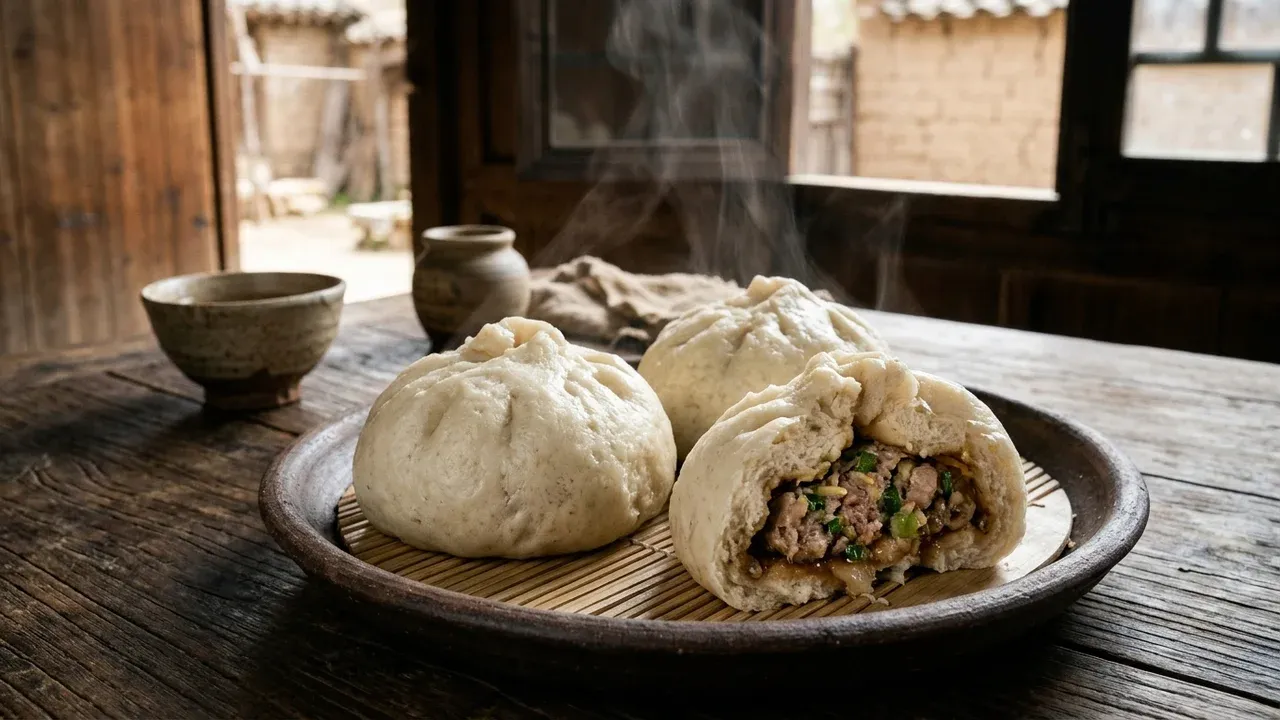
Gao Cheng's Shiwu Jiyuan (Book 9) records the legendary origin of mantou as Zhuge Liang sacrificing flour-wrapped meat instead of human heads during his southern campaign.
Meng Yuanlao's Dongjing Menghualu describes mantou widely sold as popular street food and evening market fare in the Northern Song capital Kaifeng.
The Yuan-era court manual Yinshan Zhengyao records detailed culinary recipes for steamed stuffed buns using mutton and sheep fat.
Inference and interpretation
- The attribution of mantou's invention to Zhuge Liang in the 3rd century is a literary origin legend popularized in the Song period rather than an archaeological fact.
Modern adjustments
- Mutton and fat from the Yuan recipes are replaced with domestic ground pork, and modern active dry yeast is used for reliable home steaming.
- Quantities and times are household design choices; this site has not cooked or shelf-life tested the recipe.
Sources and references
- 高承『事物紀原』巻九「饅頭」
- Publication or composition year
- 北宋(11世紀末)
Open source: https://zh.wikisource.org/zh-hant/事物紀原_(四庫全書本)/卷09The electronic text was verified; it records the legend of Zhuge Liang offering flour-wrapped meat instead of human heads during his southern expedition.
- 孟元老『東京夢華録』巻二・巻三
- Publication or composition year
- 南宋(1147年頃成立)
Open source: https://ctext.org/dongjing-meng-hua-lu/zhThe electronic text was verified; records street stalls and night markets selling mantou in the Northern Song capital Kaifeng.
- 忽思慧『飲膳正要』巻一「聚珍異饌」
- Publication or composition year
- 元代(1330年)
Open source: https://zh.wikisource.org/wiki/飲膳正要/聚珍異饌The electronic text was verified; records specific court recipes for steamed stuffed buns using mutton and sheep fat.
- 厚生労働省:家庭でできる食中毒予防の6つのポイントOpen source: https://www.mhlw.go.jp/www1/houdou/0903/h0331-1.html
General guidance on 75°C for 1 minute, portioned cooling and refrigeration. The 4°C limit is our household handling choice, not a quotation of the source’s 10°C guidance.