HISTORICAL RECORD
Historical Sources and Evidence
These sources provide historical context. They do not necessarily support the quantities or cooking times in the modern adaptation.
Registered as a reconstruction based on sources. Distinguish the source's account from inference and modern adjustments.
Statements supported by sources
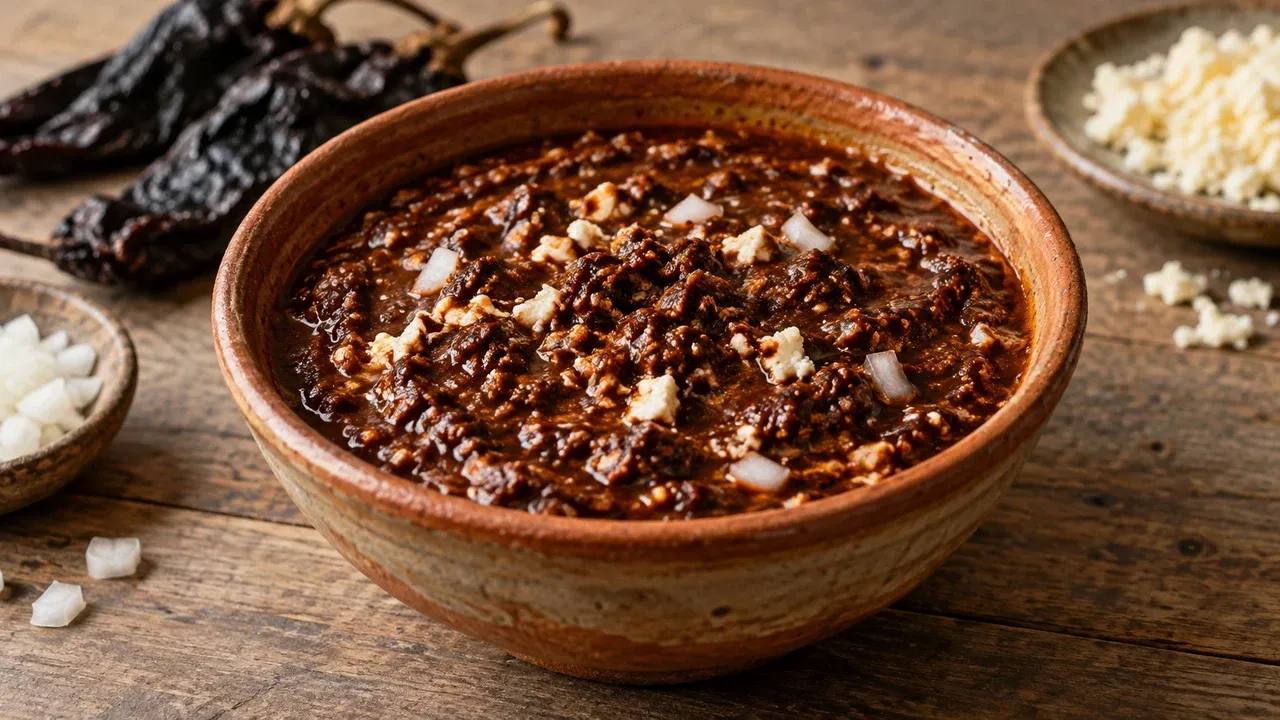
UTSA’s transcription of recipe No.29 from the 1831 book toasts ancho and pasilla, then combines them with pulque, garlic, seeds, onion, oil and aged cheese.
Inference and interpretation
- Chile macho names this particular formula, not every modern sauce with that name. Pulque is a fermented agave drink.
Modern adjustments
- Water replaces pulque, and the chiles are briefly simmered before grinding. Chile weights, salt, product choices and all quantities are modern; the fermented flavor is not fully recreated.
- Quantities and times are home-kitchen settings; cooking verification remains untested.
Sources and references
- El cocinero mexicano (1831), Tomo I, No.29 De Chile macho, p.138; UTSA Libraries transcription and translation
- Publication or composition year
- 1831; UTSA post 2010
Open source: https://lacocina.utsa.edu/salsas-1831/The relevant electronic text, translation or transcription was read. Original manuscript and edition images were not collated; see the STEP257 record for scope and limitations.
- 厚生労働省:家庭でできる食中毒予防の6つのポイントOpen source: https://www.mhlw.go.jp/www1/houdou/0903/h0331-1.html
Modern general guidance on washing, cooking, cooling in small portions and refrigeration; not a shelf-life study or cooking trial of this formula.