HISTORICAL RECORD
Historical Sources and Evidence
These sources provide historical context. They do not necessarily support the quantities or cooking times in the modern adaptation.
Registered as a reconstruction based on sources. Distinguish the source's account from inference and modern adjustments.
Statements supported by sources
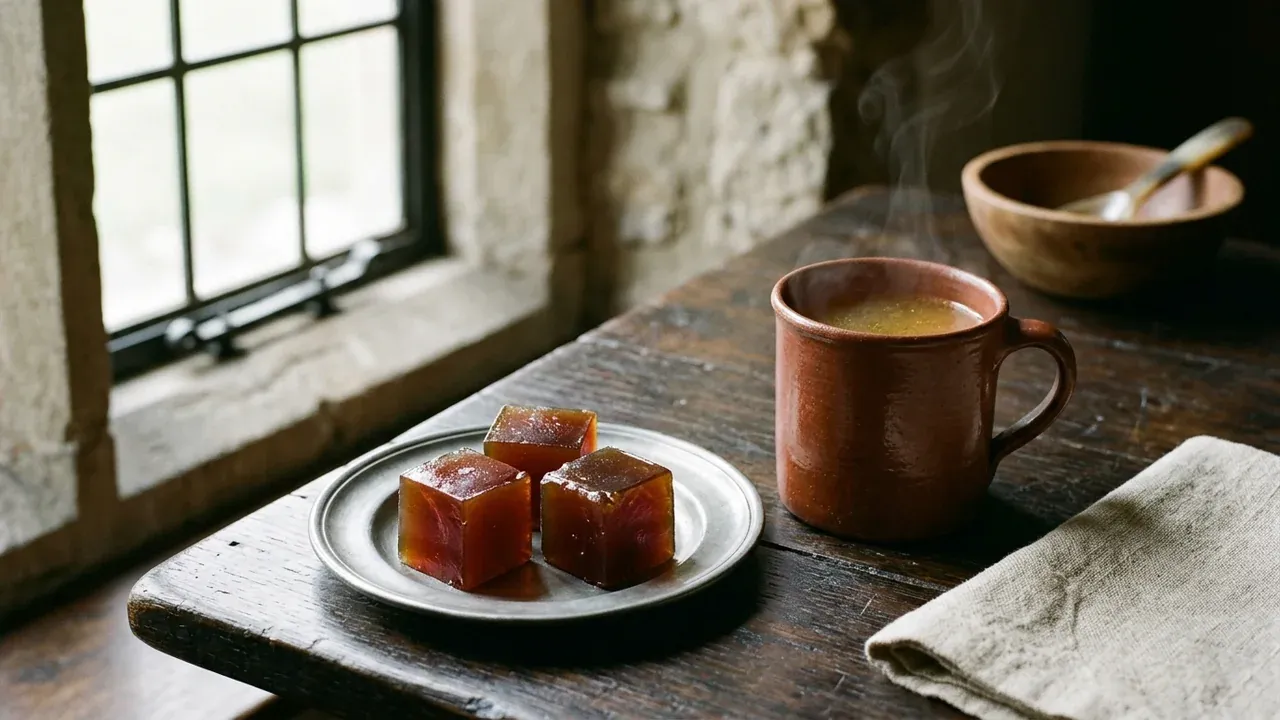
The electronic Chapter VI transcription of Glasse gives a beef, anchovy, onion and spice recipe followed by straining, defatting, reduction and drying. Colonial Williamsburg also publishes a quotation with matching main ingredients, attributing it to her 1747 cookbook.
Inference and interpretation
- Original printed pages have not been checked and the transcription’s base edition is uncertain. The neighbouring veal pocket-soup is a different formula; this proposal draws on the beef portable soup.
- The reported museum inventory and Cook-voyage connection could not be verified here and are omitted. Cubes, tableware and background are modern illustration, not an established 18th-century appearance.
Modern adjustments
- The 500g beef, 1,500mL water, seven-ingredient mixture and timings are modern, not a proportional scaling. Mace, cloves, other herbs and bread crust are omitted.
- Do not reproduce ambient air-drying. Prompt cooling after straining and reduction, refrigeration and freezing replace it. About 1 month is a quality guide; freezing is not a treatment that removes every microbe or toxin.
- Contains beef and fish (anchovy). Check processed-product allergen labels and prevent raw meat contaminating other foods. Discard improperly stored stock without tasting.
- Untested and not tasted. Yield, cube strength, cooling time and storage life have not been verified.
Sources and references
- Hannah Glasse, The Art of Cookery Made Plain and Easy, Chapter VI — To make portable soup (electronic transcription; base edition unconfirmed)
- Author
- Hannah Glasse
- Publication or composition year
- First publication 1747; transcription edition unconfirmed
Open source: https://www.fabulousfusionfood.com/georgian/glasse-soups-broths-06.phpEnglish transcription read, but its introduction says 1747 and footer says 1774; its base edition is unconfirmed. Original 1747 pages and pagination not checked. Veal pocket-soup and beef portable soup are distinct. Main beef-recipe ingredients were cross-checked against the quotation published by Colonial Williamsburg.
- Colonial Williamsburg Interpreter, Vol. 21, No. 1 (Spring 2000), p. 18 — quotation of Glasse’s portable soup
- Publication or composition year
- 2000
Open source: https://digitalcollections.colonialwilliamsburg.org/API/Download/v1_0/GetOriginalLimited?Identifier=CW11A967&SourceAction=API_VIEW_DETAILS_TRX&UsePreviewPdf=FalseMuseum institution’s secondary PDF text consulted; its quotation attributed to 1747 lists beef, anchovies, spices, onions, herbs and bread crust. This is not direct inspection of the original edition.
- FDA: Safe Food HandlingOpen source: https://www.fda.gov/food/buy-store-serve-safe-food/safe-food-handling
General modern cooling, refrigeration around 4°C or below and freezing around -18°C or below; not a storage trial of this dish.