Late 18th century (1796, United States)
1796 Pumpkin Pie (Pompkin No. 2)
An early American pumpkin pie recorded in Amelia Simmons's landmark 1796 cookbook 'American Cookery', flavored with molasses, ginger, and allspice rather than refined white sugar. An untested home-kitchen recreation adjusting this historic custard pie for modern culinary safety and domestic baking tins.
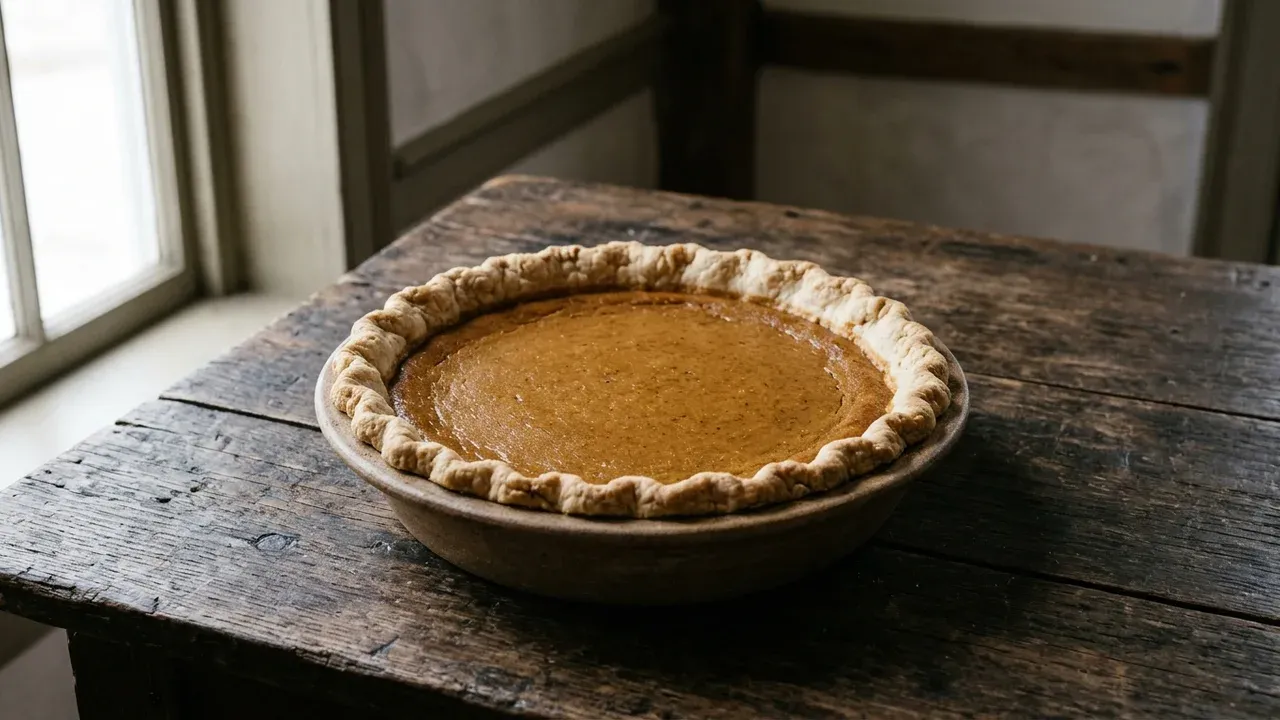
MODERN RECREATION
Modern Adaptation Proposal
Ingredients
Instructions
- Prepare the pumpkin: scoop out seeds and fibers, then steam until tender or roast in a 180°C oven until easily pierced with a skewer. Scoop flesh from the skin and pass through a fine sieve while warm to create a smooth purée. Allow to cool completely, then accurately weigh 240g of the cooled purée.
- Make the shortcrust pastry: in a mixing bowl, combine sifted low-protein pastry flour and salt. Add chilled butter cubes. Using fingertips or a pastry cutter, rub butter into the flour until it resembles coarse, crumbly meal with pea-sized bits. Sprinkle cold water gradually, tossing lightly until dough just comes together without kneading. Shape into a flat disk, wrap in plastic, and chill in the refrigerator for 30 minutes. [Hygiene Caution: Never consume raw dough containing uncooked flour. Wash hands, utensils, and work surfaces thoroughly before and after preparation]
- Roll and line the tin: on a lightly floured surface, roll chilled dough to approximately 3mm thickness and a circle of 24–26cm diameter (large enough to line the base and sides of a deep 20cm pie tin of 3.5–4cm depth, with approx. 1L volume reference; check actual tin dimensions and capacity beforehand). Gently fit into the tin without stretching, trimming excess pastry along the rim. Prick the base evenly with a fork. Chill the lined tin in the refrigerator for an additional 15 minutes to prevent shrinkage.
- Blind bake the crust: preheat oven to 180°C. Line the chilled pastry with parchment paper and fill completely with pie weights or dried beans. Bake at 180°C for 20 minutes, then carefully remove weights and paper. Return crust to the oven for 5 to 10 minutes until the base is dry and lightly golden. Remove and cool slightly on a wire rack. [Caution: The pie dish and baking weights will be extremely hot; handle with care to avoid burns]
- Mix the filling: in a separate bowl, whisk together the cooled pumpkin purée, beaten eggs, molasses, ground ginger, and ground allspice until smooth and uniform. Gradually pour in milk while whisking gently until you have a smooth, fluid custard filling. [Critical Hygiene Notice: This filling contains raw eggs and uncooked ingredients. To prevent foodborne illness such as Salmonella, never taste the raw filling]
- Fill the pie shell: gently pour the blended filling into the blind-baked crust. Leave a 7–10mm margin below the top rim to allow for expansion during baking without overflowing. (If any excess filling remains, do not overfill; bake separately in small heatproof ramekins).
- Bake and observe: preheat oven to 175°C. Place the pie tin on a baking sheet and bake on the lower-middle rack for approximately 45 to 65 minutes (note: the original text specifies 'bake 1 hour', but modern oven times serve as an unverified observational guide). Begin checking at around 40 minutes: the edges should be gently puffed and set, while the center should have a slight, delicate jiggle like set gelatin when gently nudged (not watery or rippling in waves), serving as an auxiliary visual cue. Tent loosely with aluminum foil if crust edges brown too quickly.
- Verify internal core temperature and cool safely: check doneness by inserting a food thermometer into the center of the custard filling without touching the bottom or sides of the dish. Confirm that the core temperature reaches at least 75°C (167°F) and is maintained for at least 1 minute as an official public health guideline reference (this temperature condition is a general food safety benchmark, not an empirically verified value achieved in this untested formulation). If undercooked, bake in additional minute increments and retest. If baking excess filling in separate ramekins, verify core temperature for each container independently. Visual cues such as skewer testing, jiggle, and surface browning are auxiliary only and must not replace thermometer measurement. If using an in-oven probe, ensure it is oven-safe. Cool completely on a clean wire rack; do not leave standing at room temperature for extended periods. Refrigerate within 2 hours of baking (or within 1 hour if ambient room temperature exceeds 32°C/90°F) in a refrigerator maintaining 4°C (40°F) or below. [Food Safety & Storage: Never leave egg-based custard pies standing at room temperature; store promptly in the refrigerator and consume promptly]
HISTORICAL RECORD
Historical Sources and Evidence
These sources provide historical context. They do not necessarily support the quantities or cooking times in the modern adaptation.
Statements supported by sources
A recipe for pumpkin pie appears under the heading 'Pompkin' as formula 'No. 2' in Amelia Simmons's 'American Cookery', published in Hartford, Connecticut in 1796. The entry was verified against the Project Gutenberg electronic edition (eBook #12815).
The primary text for 'No. 2' specifies: 'One quart of milk, 1 pint pompkin, 4 eggs, molasses, allspice and ginger in a crust, bake 1 hour.'
The 1796 text presents two distinct 'Pompkin' recipes side-by-side: 'No. 1' specifies cream, sugar (unspecified type), mace, nutmeg, and a decorative dough lattice ('cross and chequer it'), whereas 'No. 2' specifies milk, pumpkin, eggs, molasses, allspice, and ginger 'in a crust', without specifying whether the top has a crust or lattice.
The historical entry is a concise qualitative formula stating ingredient volume ratios (1 quart milk to 1 pint pumpkin and 4 eggs) and flavorings, without detailed weights in grams, specific molasses amounts, pumpkin preparation steps, crust ratios, or oven temperature settings.
For contemporary home cooking, preventing consumption of raw flour and raw eggs, maintaining strict hygiene, mandatory food thermometer verification of core heating (reaching 75°C for at least 1 minute without pan bottom contact), avoiding extended room temperature standing, prompt refrigeration within 2 hours (or 1 hour if ambient temperature exceeds 32°C/90°F), and storage at or below 4°C (40°F) are essential public health standards.
Inference and interpretation
- Amelia Simmons's 'American Cookery' (1796) holds historic prominence as the first cookbook authored by an American and published in the United States, as highlighted in Library of Congress exhibits. Combining British pudding and pie traditions with indigenous North American produce such as squash/pumpkin and domestic sweeteners like molasses, it represents a landmark text in early American culinary history.
- The use of molasses and allspice in 'No. 2' reflects commercial staples readily available in early American seaports. In contrast to the rich cream, mace, and decorative lattice of 'No. 1', 'No. 2' has been interpreted by culinary historians as exemplifying a simpler, everyday domestic New England style, though the exact extent of its adoption across specific social classes remains a historical inference rather than a documented statistic.
- The year 1796 marks the publication of the book, not the invention date of pumpkin pie, nor can it be identified as the origin of Thanksgiving culinary traditions. Pumpkin puddings and pastry tarts existed in 17th- and 18th-century English and colonial cooking; Simmons's text provides an early American printed cookbook record of a pumpkin custard pie in a crust. Furthermore, because No. 2 specifies 'in a crust' without lattice instructions, presenting it as an open-faced pie in modern adaptation is an interpretative culinary choice rather than an explicit textual mandate.
Modern adjustments
- The historical quantities (1 quart milk, 1 pint pumpkin, 4 eggs) reflect large 18th-century cooking scale, and 18th-century liquid units did not strictly match modern US customary units. Rather than a direct proportional reduction, this untested recreation redesigns the formula to fit the volume of a modern deep 20cm pie tin (approx. 3.5–4cm depth, approx. 1L capacity, approx. 6 unverified servings) based on the original flavor profile. Commercially available culinary pumpkins are specified.
- Molasses, unmeasured in the original text, is set at a proposed 80g of mild baking sugarcane molasses to balance sweetness without harsh bitterness (distinguished from blackstrap molasses or Japanese kuromitsu). Spices are set at 1g ginger and 0.5g allspice as proposed values. Custard setting, sweetness, aroma, and final baked texture remain unverified in this untested formulation.
- A shortcrust pastry formulation (150g low-protein pastry flour, 75g butter, cold water, salt) is provided to fulfill the historical 'in a crust' instruction. Blind baking is introduced as a modern safeguard to reduce the risk of a soggy bottom from the moist custard filling.
- While the primary source indicates 'bake 1 hour', modern home ovens vary significantly; 175°C for 45 to 65 minutes is suggested as an unverified observational benchmark. Physical cues (jiggle, skewer) are auxiliary only, and measuring internal core temperature (75°C for 1 min without pan bottom contact) with a food thermometer is required.
- Adhering to public health guidance (MHLW, FDA, CDC), raw dough and batter tasting is strictly prohibited, food thermometer core verification (75°C for 1 min without pan contact) is required for each baking container, prompt refrigeration within 2 hours (or 1 hour if above 32°C/90°F) at or below 4°C (40°F) is mandated, and allergens (wheat, egg, milk) are declared.
Sources and references
- 『American Cookery』所収「Pompkin No. 2」Open source: https://www.gutenberg.org/cache/epub/12815/pg12815-images.html
Consulted the electronic edition of Amelia Simmons's 'American Cookery' (Hartford: Hudson & Goodwin, 1796; Project Gutenberg eBook #12815), specifically the entry 'Pompkin No. 2'. The primary text states: 'One quart of milk, 1 pint pompkin, 4 eggs, molasses, allspice and ginger in a crust, bake 1 hour.' While catalog records such as Library of Congress LCCN 96126967 associate this text with page 34 of the 1796 first edition, our direct textual verification was performed on the electronic transcript rather than the physical 1796 print.
- 厚生労働省「家庭でできる食中毒予防の6つのポイント」Open source: https://www.mhlw.go.jp/topics/syokuchu/dl/point.pdf
Consulted for public health hygiene guidelines regarding egg and dairy cooking: thorough core heating (75°C for at least 1 minute), sanitation of hands and utensils, prompt cooling and refrigeration within 2 hours (or within 1 hour if ambient temperature exceeds 32°C/90°F), and storage at or below 4°C (40°F).
- FDA「Safe Food Handling」食品安全指針Open source: https://www.fda.gov/food/buy-store-serve-safe-food/safe-food-handling
Consulted for official food safety guidance regarding baked egg custard dishes: avoiding raw tasting, ensuring thorough core cooking, preventing extended room temperature standing, refrigerating within 2 hours (or 1 hour if above 90°F/32°C), and storing at or below 40°F (4°C).
- CDC「Raw Flour and Dough」食品衛生ガイドラインOpen source: https://www.cdc.gov/food-safety/foods/no-raw-dough.html
Consulted for public health standards on avoiding raw dough and batter consumption containing uncooked flour or raw eggs, and preventing cross-contamination of utensils and preparation surfaces.
Image credits and sources
© History Meshi (AI-generated recreation image / AIによる再現イメージ)
Source: Modern adaptation concept based on Amelia Simmons's American Cookery (1796) / アメリア・シモンズ『American Cookery』(1796年刊)所収「Pompkin No. 2」に基づく再現イメージ
License: Original site asset (not an actual cooking or historical source photograph / 実際の調理・史料写真ではありません)