HISTORICAL RECORD
Historical Sources and Evidence
These sources provide historical context. They do not necessarily support the quantities or cooking times in the modern adaptation.
Statements supported by sources
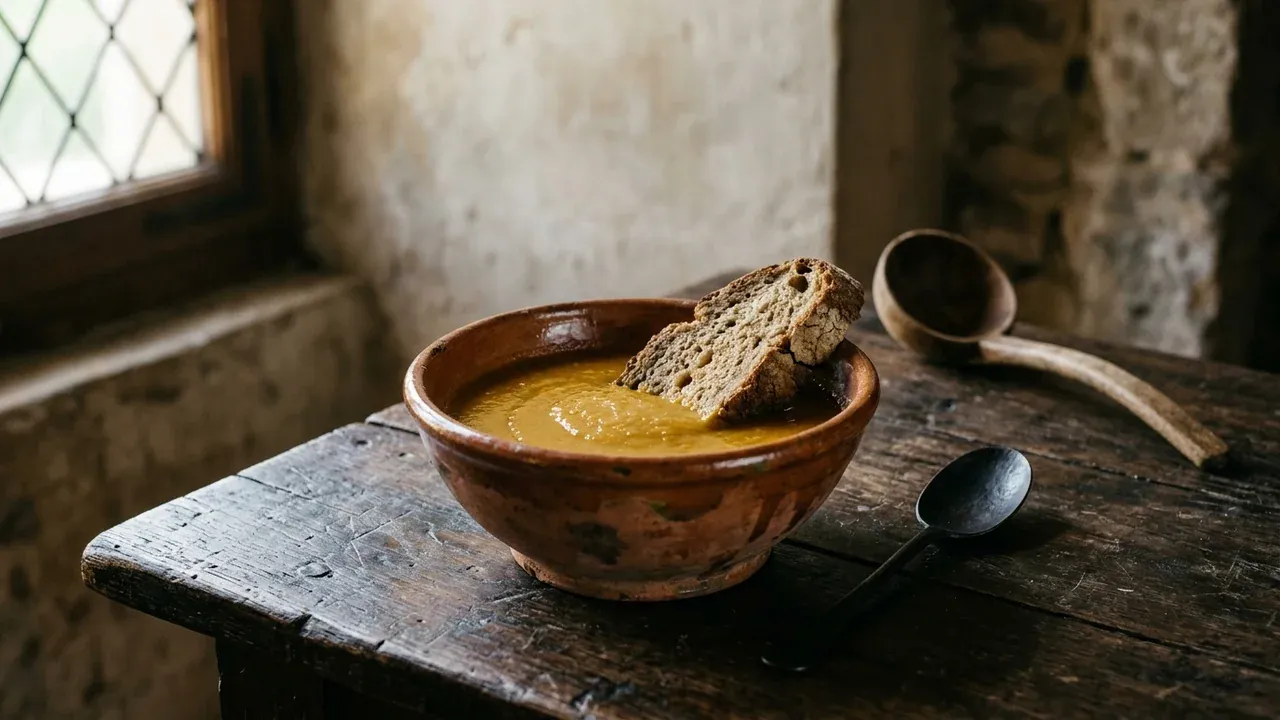
In François Pierre de La Varenne's 'Le Cuisinier François' (Paris: Pierre David, 1651), Part 2 'Des potages maigres' (Lenten potages), printed page 156, recipe no. 20 'Potage de citrouille au laict' explicitly instructs: 'Cut it, and cook as above, then pass it through a colander with milk, and boil it with butter, seasoned with salt, pepper, a clove-studded onion: And serve with diluted egg yolks as above.'
Printed page 156, baseline recipe no. 19 'Potage de citrouille au beurre' specifies the preceding procedure: 'Take your pumpkin, cut it into pieces, and cook it with water and salt: When cooked, pass it, and put it in a pot with an onion stuck with cloves, fresh butter, and pepper: let your bread simmer [soak], and if you wish, dilute three or four egg yolks, and put them with broth over it, then serve.'
Official public food hygiene standards (MHLW / FDA) establish that milk and egg preparations should reach a minimum internal temperature of 75°C for at least 1 minute, emphasize allergen awareness (dairy, wheat, egg), and require cooling and refrigeration below 4°C within 2 hours.
Inference and interpretation
- In 17th-century French culinary terminology, 'citrouille' encompassed various cucurbit species, including newly introduced New World squashes (Cucurbita pepo / moschata) as well as traditional European gourds. The original text specifies no botanical variety.
- A 17th-century 'potage' was structurally distinct from a modern liquid sipping soup: it was an assembled dish where hot broth and purée were ladled over thick, dried bread slices in the bowl, creating a comforting, semi-solid meal (pain mitonné).
- The 'oygnon picqué de cloux' (onion studded with cloves) was used as a whole aromatic infusion steeped during simmering and removed before service, rather than chopped onions sautéed into the dish.
- The 'Citrouille' entry on printed page 284 belongs to the vegetable entremets chapter, describing pumpkin sliced thin and pan-fricasseed in butter between two plates with verjus, representing a distinct side dish rather than this liquid potage.
Modern adjustments
- Adapted for home kitchens using accessible culinary squash (kabocha or butternut, 400g net), 400-500ml whole milk, 25-30g unsalted butter, 1 small whole onion studded with 3-4 cloves, salt, white pepper, and 4-6 crusty bread slices (untested proposed measurements for 2-3 servings).
- Faithfully reproduces the primary historical steps: initial parboiling in salted water, pureeing with milk, and gentle simmering with a clove-studded onion and butter (eliminating the non-historical sautéed chopped onion step found in earlier drafts).
- Incorporated modern dairy and egg safety guidelines: gentle low-heat simmering to reach 75°C for 1 minute without scorching, pasteurized egg yolk handling, allergen identification (milk, wheat, egg), and safe leftover refrigeration below 4°C.
- While a traditional coarse sieve (passoire) was historically utilized, modern home cooks may use a food mill, fine mesh strainer, or immersion blender (taking standard precautions against hot splatter).
Sources and references
- Le Cuisinier François
- Author
- François Pierre de La Varenne
- Publication or composition year
- 1651年
Open source: https://catalogue.bnf.fr/ark:/12148/cb30754438cFirst edition printed by Pierre David in Paris, 1651, recorded in the Bibliothèque nationale de France general catalogue (Notice no. FRBNF30754438). Refers to the critical transcription in the Université libre de Bruxelles (ULB) HISTOLF corpus, page 156, recipe no. 20 ('Potage de citrouille au laict') and baseline recipe no. 19 ('Potage de citrouille au beurre'). Note that the 'Citrouille' entry on page 284 belongs to the vegetable entremets section (fricassée between two plates) and is a distinct preparation.
- 家庭での食中毒予防(厚生労働省)
- Author
- 厚生労働省(MHLW)
- Publication or composition year
- 2024年
Open source: https://www.mhlw.go.jp/topics/syokuchu/dl/point.pdfOfficial consumer guidance on food poisoning prevention from the Ministry of Health, Labour and Welfare (MHLW), Japan. Refers to reaching a minimum core temperature of 75°C for at least 1 minute, allergen awareness, equipment sanitation, preventing cross-contamination, and prompt cooling/refrigeration below 4°C.