Late 14th century (c. 1393, Paris, France)
Crespes
A crisp, medieval French fritter recorded in the late 14th-century Parisian household guide 'Le Ménagier de Paris', made by streaming batter through a pierced vessel into sizzling fat. An untested domestic recreation adapting this historical recipe for modern home kitchens with contemporary safety considerations.
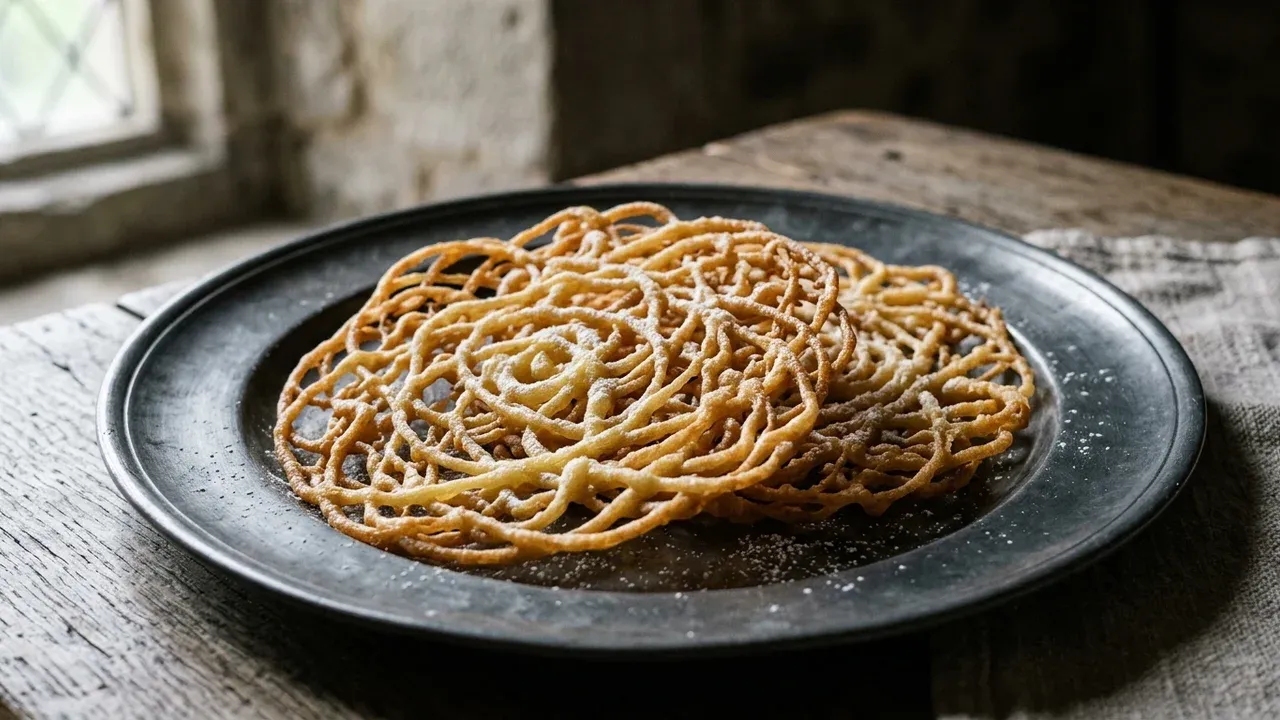
MODERN RECREATION
Modern Adaptation Proposal
Ingredients
Instructions
- In a mixing bowl, combine sifted flour and salt. Add beaten egg and white wine (or water), and whisk together. Gradually pour in water while whisking thoroughly to create a smooth, lump-free batter that drizzles steadily in a fine thread (adjust water depending on flour characteristics). [Important Hygiene Notice: Never consume raw batter containing uncooked flour or raw egg. Do not leave prepared batter at room temperature for long periods, and thoroughly wash hands, utensils, and surfaces before and after handling]
- Prepare a food-grade, heat- and oil-resistant piping bag (tip trimmed to 4–5mm opening), a squeeze dispenser bottle, or a funnel, and pour in the batter. Test the flow by dropping a little batter into a bowl away from the stove. [Safety Caution: Take care not to let hands or tools touch hot oil, pan edges, or flames. Keep the outside of the tool clean and dry, and never force batter or clear clogs directly over the heat]
- Pour cooking oil into a stable, deep pan suitable for frying. Prioritize your stove and cookware instruction manuals regarding suitable pans, minimum oil amounts, and cooking modes; never use less than the manufacturer's specified minimum oil volume. Heat over medium-low heat to approximately 160–170°C, monitoring with a cooking oil thermometer. [Critical Fire Safety Procedure: Never leave heating oil unattended and do not overheat. If the oil ignites, never add water or move the pan. Turn off the heat only if safe and keep an escape route clear. Use an extinguisher rated for cooking-oil fires only for a small fire that can be tackled safely, following its instructions. Otherwise evacuate immediately without approaching the pan and call emergency services (119 in Japan, or your local emergency number)]
- Maintaining a safe distance above the oil surface (low enough to avoid splashing, but not touching the oil), stream the batter continuously from the center outward in overlapping spirals to form a round shape about 12–14cm in diameter (keep amounts modest as this is an untested recipe). [Safety Caution: Adding too much batter at once can cause oil to surge and overflow dangerously. Ensure kitchen ventilation is active and keep clothing and sleeves away from flames]
- Fry over medium-low heat for 1 to 1.5 minutes until the underside is pale golden and firm. Gently flip using a spatula or tongs (flipping is a modern adjustment for even cooking in domestic pans, not specified in the original entry), and fry the other side for 30 seconds to 1 minute (approx. 1.5–2.5 minutes total). [Hygiene & Thorough Cooking: Ensure the batter is cooked through to the center of overlapping layers. Never consume pastry with raw batter inside, and do not judge doneness solely by surface color or elapsed time. Flip gently to avoid splashing oil]
- Drain thoroughly on a clean wire rack or paper towels (using clean utensils separate from raw batter tools). Transfer while hot to a clean serving plate and dust generously with powdered sugar through a fine sieve. Serve warm. [Caution: Freshly fried pastry and oil are extremely hot; avoid burning the mouth]
HISTORICAL RECORD
Historical Sources and Evidence
These sources provide historical context. They do not necessarily support the quantities or cooking times in the modern adaptation.
Statements supported by sources
In the late 14th-century Parisian household book 'Le Ménagier de Paris' (composed c. 1393), Section II, Article 5 records a recipe for fried pastry under the name 'Crespes'. The text was verified directly against Baron Jérôme Pichon's 1846 printed edition, Tome II, p. 226 (without printed recipe number in the primary text).
The historical text explicitly prescribes flour (fleur), whole eggs with the part called germ removed (œufs tant moyeux comme aubuns, osté le germe), water (eaue), salt (sel), wine (vin), lard or half lard and half fresh butter (sain, ou moitié sain ou moitié beurre frais) for frying, and powdered sugar (pouldre de succre) for dusting.
The source specifies heating fat in an iron or brass (arain) pan (paelle) until sizzling (fremier), placing the batter in a bowl pierced with a hole the size of a little finger (escuelle percée d'un pertuis gros comme vostre petit doit), streaming it from the center outward across the pan, and serving on a plate sprinkled with sugar.
The historical entry is a qualitative description of ingredients, pan dimensions (holding three choppines, with sides half a finger high, cylindrical), and method; specific metric weights, counts, frying temperatures, and minutes are absent from the medieval text.
In modern domestic cooking, adhering to manufacturer minimum oil volumes, preventing overheating, never adding water to burning oil, using suitable extinguishers with early evacuation, practicing strict hygiene with raw flour and eggs, and checking allergen declarations are indispensable for public safety.
Inference and interpretation
- The name 'Crespes' derives from Old French 'crespe' (curled, crinkled, from Latin crispus), sharing linguistic ancestry with modern French 'crêpe'. Unlike modern flat-griddled crêpes, medieval crespes were distinct fried fritters created by streaming batter through a pierced vessel into hot fat. Lace-like or bird's-nest shapes represent a modern reconstructive interpretation based on overlapping fine streams.
- While the original text specifies simply 'vin' (wine) without designating color, dry white wine is a modern culinary choice for aroma. Removing the 'germe' (germ) of the eggs has been interpreted as removing chalazae to achieve a smooth streaming batter, though whether this matches modern anatomical terms remains uncertain. The adjacent recipe 'Crespes a la guise de Tournay' specifies warm white wine and flipping with skewers, which are distinct from this entry.
- 'Le Ménagier de Paris' is not a royal court banquet collection, but a practical domestic manual compiled by a wealthy bourgeois gentleman for his young bride. The use of expensive powdered sugar reflects the refined dining culture of late-medieval prosperous urban households, though widespread consumption across medieval France cannot be asserted from this source alone.
Modern adjustments
- Due to the absence of specific measurements in the source, this domestic recreation has been independently scaled (100g flour, 1 egg) as an untested home proposal. Cookware and oil volume prioritize manufacturer instructions for stable, deep frying pans rather than the historical shallow vessel.
- In place of the historical pierced bowl, modern food-grade heat-resistant piping bags, squeeze dispenser bottles, or funnels are suggested, with precautions to test flow in advance and prevent burns or splatters.
- While the historical fats are lard or lard blended with butter, standard vegetable frying oil is adopted as the primary modern domestic option. Butter may be added for flavor but requires careful temperature management due to risks of milk solid scorching, moisture splattering, and smoking.
- Dry white wine was selected for pleasant aroma, but because alcohol may remain after cooking, complete substitution with water is provided for children and alcohol-sensitive individuals. Flipping the pastry is a modern adjustment for domestic frying pans. Overlapping centers must be thoroughly cooked to avoid raw dough.
- Official public safety standards (NITE, Yokohama Fire Bureau, US CDC) are integrated, covering cookware oil limits, overheating prevention, grease fire protocols, raw flour/egg hygiene, and allergen notifications for wheat, egg, and dairy.
Sources and references
- 『ル・メナジエ・ド・パリ(Le Ménagier de Paris)』第2巻 第二部第五項「Crespes」Open source: https://archive.org/details/le-menagier-de-paris-tome-02-bsb
Consulted via Baron Jérôme Pichon's edition 'Le Ménagier de Paris' (Paris: Crapelet, 1846, Tome 2, p. 226), Section II, Article 5, 'Crespes' (without printed recipe number). The source qualitatively describes ingredients (flour, whole eggs, water, salt, wine, fat, powdered sugar) and method (pouring through a pierced vessel into hot fat in spirals), but lacks specific weights, counts, temperatures, and times. Medieval manuscripts were not physically collated.
- 製品安全注意喚起「揚げ物調理における注意と事故防止」Open source: https://www.nite.go.jp/jiko/chuikanki/press/2022fy/prs220901.html
Consulted for official safety guidance on adhering to minimum cooking oil volumes, using designated cookware, avoiding overheating risks with small oil quantities, and never leaving heating oil unattended.
- 横浜市消防局「天ぷら油火災 ナベのフタによる初期消火と注意点」Open source: https://www.city.yokohama.lg.jp/bousai-kyukyu-bohan/shobo/kasaisonae/shoki/tenpura/tenpura3.html
Consulted for official fire department emergency response procedures regarding cooking oil fires: never add water, never move a burning pan, turn off heat only if safe, keep escape routes clear, use suitable extinguishers, and evacuate/call emergency services.
- CDC「Raw Flour and Dough」食品衛生ガイドラインOpen source: https://www.cdc.gov/food-safety/foods/no-raw-dough.html
Consulted for public health guidelines on preventing consumption of raw dough containing uncooked flour and raw eggs, thorough cooking, and hand/utensil hygiene to prevent cross-contamination.
Image credits and sources
© History Meshi (AI-generated recreation image / AI生成による再現イメージ)
Source: Modern adaptation concept based on Le Ménagier de Paris (c. 1393) / 『ル・メナジエ・ド・パリ(Le Ménagier de Paris)』(1393年頃)に基づく現代向け再現案の料理イメージ
License: Original site asset (not an actual cooking or historical source photograph / 実調理・史料写真ではありません)