13th century (Al-Andalus & Maghreb)
13th-Century Andalusian Lentil and Lettuce Stew (Muzawwara)
A fragrant, gentle vegetarian stew called 'Muzawwara' from a 13th-century Andalusian cookbook. Tender split red lentils and fresh lettuce are simmered with extra virgin olive oil, ground coriander, saffron, cinnamon, and white wine vinegar. Modern untested home adaptation.
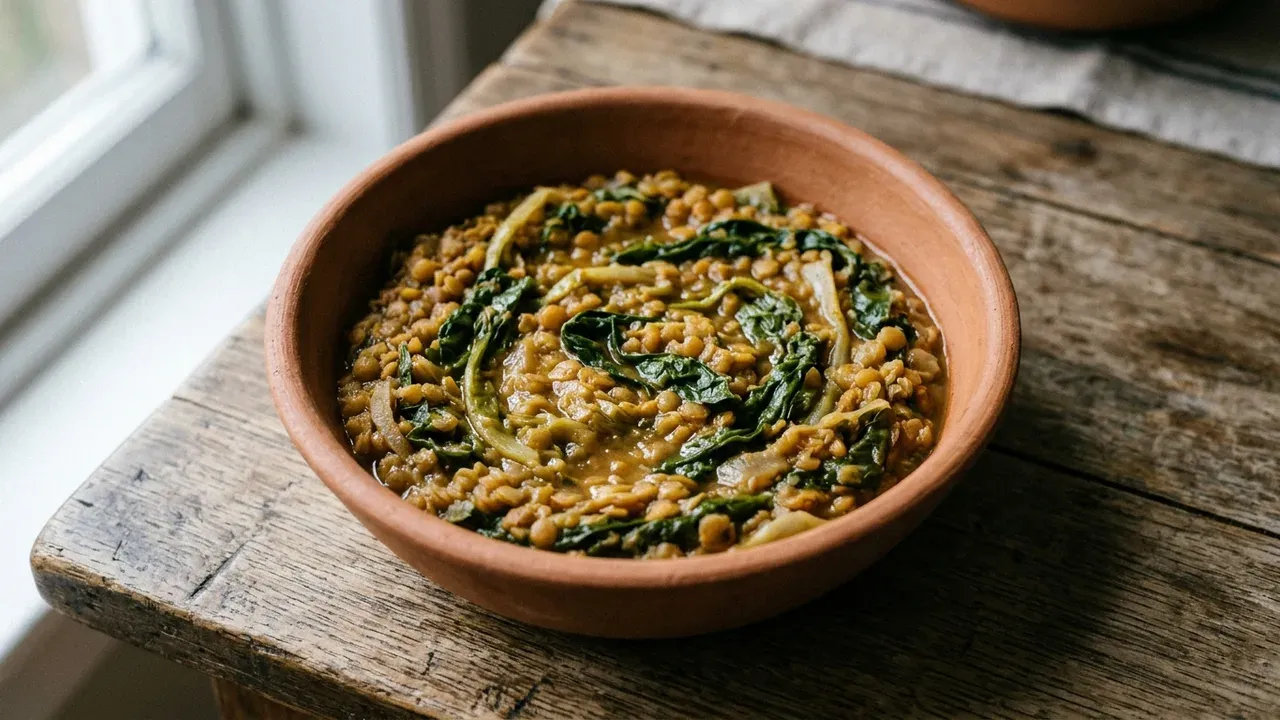
MODERN RECREATION
Modern Adaptation Proposal
Ingredients
Instructions
- Place the dried split red lentils in a fine-mesh sieve and rinse quickly under running or lukewarm water according to package instructions; drain well. Wash lettuce thoroughly under running water and pat dry. [Hygiene Note: Keep hands, utensils, and surfaces clean; avoid cross-contamination with raw meats.]
- In a small pot, combine the rinsed lentils and water (remaining water after reserving ~10 mL for saffron) over medium heat. Bring to a boil, skim off foam, reduce heat to low, tilt lid slightly, and simmer for about 10 minutes, stirring occasionally from the bottom to prevent sticking.
- Chop firmer lettuce stems into 2 cm pieces and stir into the pot. Add olive oil (12g), ground coriander, cumin, cinnamon, steeped saffron liquid, and salt (1.5g). Continue simmering gently for about 5 minutes until lentils are fully tender and easily crushed between fingers. Add a small splash of hot water if stew thickens too quickly to prevent scorching. [Burn Warning: Watch for hot steam and boiling splashes.]
- Confirm that lentils are completely tender before proceeding. Tear tender lettuce leaves into bite-sized pieces, fold into the pot, and drizzle in white wine vinegar (10mL). (Adding vinegar after lentils are tender ensures proper softening). Stir gently over low heat for 1 to 2 minutes until leaves just wilt, then remove from heat. Taste and adjust salt and acidity.
- Ladle into bowls to enjoy warm as a comforting stew. To serve chilled following the historical instruction, transfer to a shallow clean container to cool rapidly, then refrigerate at or below 4°C (40°F) within 2 hours (1 hour if room temperature exceeds 32°C/90°F). [Food Safety Note: Do not leave legume stews at room temperature; cool promptly and refrigerate. Measurements and timings are untested suggestions.]
HISTORICAL RECORD
Historical Sources and Evidence
These sources provide historical context. They do not necessarily support the quantities or cooking times in the modern adaptation.
Statements supported by sources
Documented in an anonymous 13th-century Andalusian culinary manual (Almohad era) as a 'Muzawwara beneficial for tertian fevers and acute fevers'.
The primary text instructs taking boiled, peeled lentils (boiled peeled lentils) and washing them several times in hot water, then placing them in a pot with water that does not cover them (without covering them).
Vegetable choices specified in the original include gourd pieces, Swiss chard stems/ribs, lettuce and its tender sprigs, or cucumber and melon flesh.
Seasonings include vinegar, coriander seed, a little cumin, Chinese cinnamon, saffron, two ûqiyas of fresh oil (two ûqiyas of fresh oil), and salt, balanced until 'pleasingly balanced between sweet and sour'.
The recipe explicitly directs leaving the dish to lose its heat until it is completely cold before serving.
Inference and interpretation
- The Arabic term 'muzawwara' literally means 'counterfeited' or 'falsified', used in the medieval Islamic culinary tradition for meatless vegetarian dishes imitating richer fare, often prepared for invalids, fasts, or simple meals.
- In medieval Islamic medicine, dietetics formed the core of patient care; this recipe is presented as dietary management for feverish conditions. This reflects historical medical thought, without asserting fixed humoral qualities or claiming modern clinical efficacy.
- While the Andalusian text specifies 'fresh oil', the exact variety was not defined, though olive oil was standard in the western Mediterranean. Extra virgin olive oil is chosen as a suitable modern culinary selection.
- Among the documented vegetable options, lettuce was chosen for this modern reconstruction due to its year-round availability and delicate harmony with lentils.
Modern adjustments
- Rather than pre-boiling lentils and washing in hot water as described in the historical text, this modern home adaptation uses dried split red lentils cooked directly in one pot.
- Because total batch size and servings are not specified in the original, the 12g of olive oil for two servings (100g lentils) is an independent home design rather than a direct proportional conversion of 2 ûqiyas.
- Water (450mL) serves as an initial guideline; water should be replenished as needed to prevent scorching. Vinegar is added only after lentils are tender, as acid inhibits legume softening.
- While the medieval text specifies serving it completely cold, this adaptation can also be enjoyed warm. All proportions, cooking times, and textures are untested modern proposals.
Sources and references
- An Anonymous Andalusian Cookbook of the Thirteenth Century (A Muzawwara)Open source: https://www.pbm.com/~lindahl/cariadoc/islamic_w_veggies.html#21
Consulted the section 'Dishes with Vegetables', 'A Muzawwara (Vegetarian Dish) Beneficial for Tertian Fevers and Acute Fevers' (modern editorial citation: Andalusian p. A-52) from Charles Perry's English translation of the 13th-century text known as 'An Anonymous Andalusian Cookbook of the Thirteenth Century' (based on the Arabic edition by Ambrosio Huici Miranda, digital version in Cariadoc's Miscellany). The text describes taking boiled peeled lentils, washing them in hot water several times, cooking in minimal water, adding vegetables such as lettuce and tender sprigs, seasoning with vinegar, coriander seed, a little cumin, Chinese cinnamon, saffron, two ûqiyas of fresh oil, and salt, balancing sweet and sour notes, and letting it cool before serving. This article references Perry's published English translation; the original Arabic manuscript and Huici Miranda's printed edition were not directly inspected.
- 厚生労働省「家庭でできる食中毒予防の6つのポイント」Open source: https://www.mhlw.go.jp/topics/syokuchu/dl/point.pdf
Consulted for official food safety guidance regarding kitchen hygiene and cooked foods: proper handwashing, clean utensils, preventing cross-contamination, timely consumption, preventing room temperature standing, and prompt refrigeration after cooling.
- FDA「Safe Food Handling」食品安全指針Open source: https://www.fda.gov/food/buy-store-serve-safe-food/safe-food-handling
Consulted for official food safety guidance regarding cooling and refrigeration of cooked foods: avoiding the temperature danger zone, refrigerating within 2 hours (or 1 hour if above 90°F/32°C), storing at or below 40°F (4°C), and rinsing produce under running water.
Image credits and sources
© History Meshi (AI-generated recreation image / AIによる再現イメージ)
Source: Modern adaptation concept based on an entry in An Anonymous Andalusian Cookbook of the Thirteenth Century / 『13世紀アンダルス料理書(作者不詳)』に基づく再現イメージ
License: Original site asset (not an actual cooking or historical source photograph / 実際の調理・史料写真ではありません)