HISTORICAL RECORD
Historical Sources and Evidence
These sources provide historical context. They do not necessarily support the quantities or cooking times in the modern adaptation.
Statements supported by sources
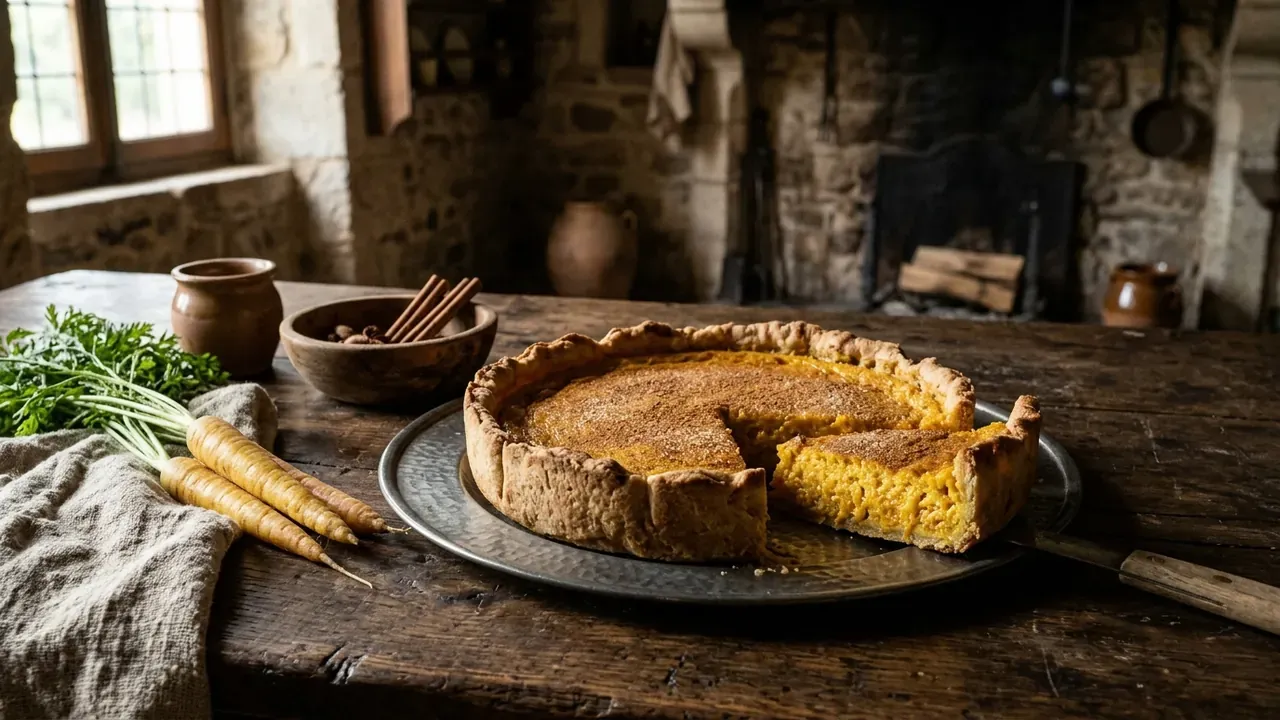
Bartolomeo Scappi's 1570 Opera (Book V, Cap. CXI, p. 363) describes a yellow carrot tart: parboiled yellow carrots simmered in meat broth and chopped with mint and marjoram, combined with Parmigiano, fat cheese, provatura, pepper, Neapolitan mostaccioli, cinnamon, candied bitter orange peel, sugar, 8 eggs, and butter, baked between pastry sheets and finished with a sugar, cinnamon, and rosewater (acqua rosa) glaze.
Inference and interpretation
- Renaissance carrots were predominantly yellow or purple before modern orange cultivars became widespread in Europe.
- Combining root vegetables with sweet spices, dairy, and eggs was a signature style of Renaissance banqueting cuisine.
Modern adjustments
- Fresh ricotta is used as an accessible modern domestic substitute for Renaissance Rome's fresh buffalo provatura and cacio grasso cheeses.
- Rosewater is an authentic primary source ingredient specified by Scappi in Cap. CXI for the top crust glaze (acqua rosa); here, 1/2 tsp is folded into the filling to impart its historical fragrance. Ground almond flour and fresh ricotta substitute for the historical assortment of Italian cheeses and spiced mostaccioli biscuits, and the original large 8-egg banquet proportions are scaled down for a domestic 18–20 cm tart shell.
- Bake thoroughly at 180°C until the egg and cheese custard is fully set; do not leave leftovers at room temperature after cooling, and refrigerate promptly.
Sources and references
- Opera dell'arte del cucinare
- Author
- Bartolomeo Scappi
- Publication or composition year
- 1570
Open source: https://archive.org/details/operavenetiascap00scapBook V (Torte e pasticci), Cap. CXI (Cap. 111, p. 363 / fol. 363r–363v) "Per fare torta di carote, & d'altre radiche, & altre materie". Parboiled yellow carrots simmered in meat broth, finely chopped with mint and marjoram, mixed with grated Parmigiano/Riviera cheese, unsalted fat cheese, provatura, crushed pepper, Neapolitan mostaccioli, cinnamon, candied bitter orange peel, sugar, 8 eggs, and butter, baked between pastry sheets, and finished with a glaze/crust of sugar, cinnamon, and rosewater (acqua rosa).