← Back to recipes

c. 1350 Medieval Germany

Heidenische Kuechlein (c. 1350 Medieval German Meat & Apple Pastries)

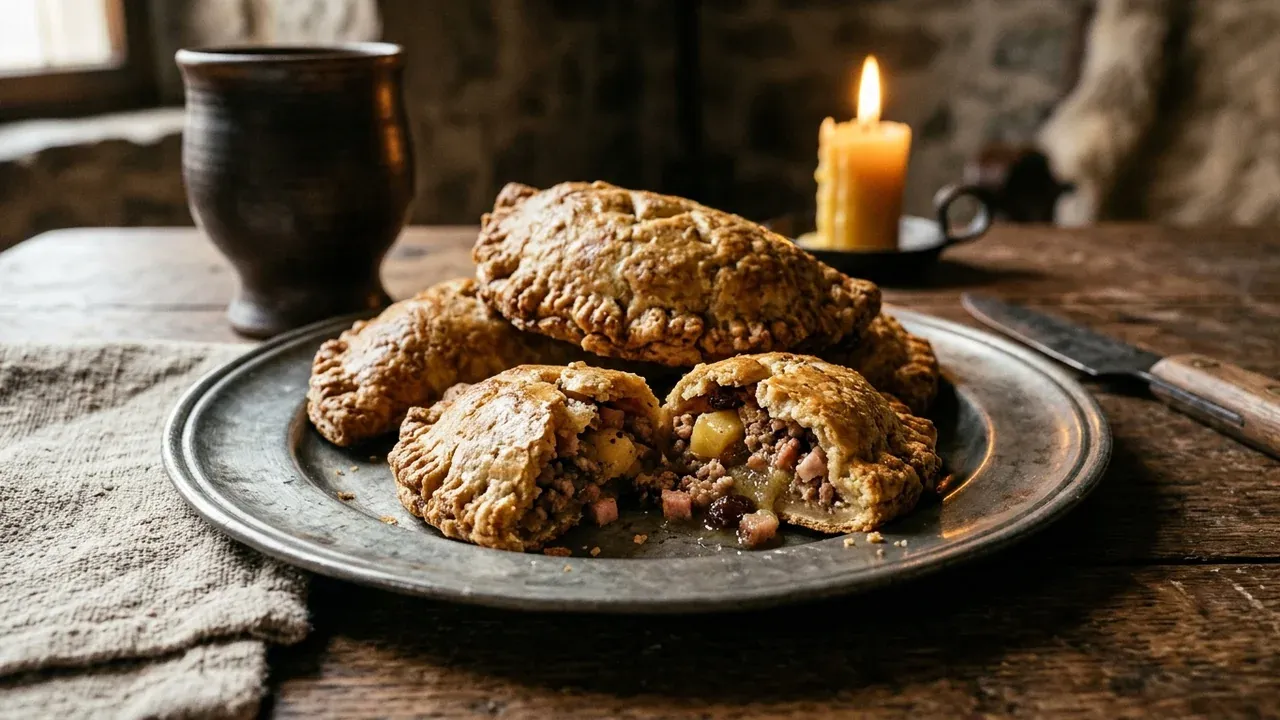
From the oldest German cookbook Das Buch von guter Spise, these golden pastry turnovers encase a savory-sweet filling of minced boiled meat, bacon, diced apples, black pepper, and egg.

AI recreation of 14th-century Medieval German Heidenische Kuechlein: golden crescent-shaped pastry turnovers filled with minced boiled beef, bacon, tart apples, and black pepper on a rustic wooden board.

MODERN RECREATION

Modern Adaptation Proposal

Ingredient quantities, cooking times, and tools are proposed for modern home cooking. They are not measurements from the historical source.

Ingredients

Tart apples combined with savory bacon and spicy black pepper showcase the distinct medieval taste profile.

Instructions

  1. Finely mince the boiled beef, bacon, and peeled apple into small uniform pieces.
  2. In a bowl, combine minced beef, bacon, apple, black pepper, salt, and 3/4 of the beaten egg. Mix thoroughly until evenly bound.
  3. Roll out puff pastry sheets to about 2mm thick and cut into 4 to 6 rounds of 10-12cm (4-5 inches) in diameter.
  4. Place filling in the center of each round. Moisten edges with water, fold over into crescent turnovers, and crimp edges firmly with a fork to seal.
  5. Arrange on a parchment-lined baking sheet. Brush tops lightly with the remaining beaten egg and cut two small slits on top for steam release.
  6. Bake in a preheated oven at 200°C (400°F) until golden, allowing 18–20 minutes as a guide. Check the center of the filling with a thermometer and continue heating until it stays at or above 75°C (167°F) for at least 1 minute.
  7. Let cool briefly on a rack and serve warm. Refrigerate leftovers promptly in small portions and reheat until hot in the center.

HISTORICAL RECORD

Historical Sources and Evidence

These sources provide historical context. They do not necessarily support the quantities or cooking times in the modern adaptation.

Statements supported by sources

  • In Das Buch von guter Spise (c. 1350; LMU Munich Cim. 4) Recipe 5a, dough is wrapped around a filling of minced boiled meat (gesoten fleisc), chopped bacon (gehackten spec), apples (epfele), pepper (pfeffer), and egg, and baked (vnd backe daz).

Inference and interpretation

  • The name 'Heidenische Küchlein' (heathen pastries) has various hypothesized origins, including contact with Saracen cuisine during the Crusades or folded pastry shapes. It highlights medieval appreciation for blending fruit, meat, and spices.

Modern adjustments

  • Baking is adapted to a modern 200°C oven using commercial puff pastry for consistent results.
  • Readily available boiled beef and bacon are paired with clear food safety verification of 75°C for at least 1 minute.

Sources and references

  1. Das Buch von guter Spise (The Book of Good Food)Open source: https://www.uni-giessen.de/de/fbz/fb05/germanistik/absprache/sprachverwendung/gloning/tx/bvgs.htm?set_language=de

    From Das Buch von guter Spise (c. 1350, Würzburg; LMU Munich Library Cim. 4), Recipe 5a 'Heidenische Küchlein' (ed. Thomas Gloning, University of Gießen). The text instructs to make dough, wrap a filling of minced boiled meat (gesoten fleisc), chopped bacon (gehackten spec), apples (epfele), pepper (pfeffer), and eggs, and bake it (vnd backe daz).
About this site

About our dish images
Image credits and sources

© History Meshi / AI-generated recreation

License: AI-generated modern recreation / AI生成の現代再現イメージ / AI生成的现代复原示意 / AI生成的現代復原示意 / Recreación moderna generada por IA