13th Century (Southern Song Dynasty)
Steamed Crab-Stuffed Orange (Xie Niang Cheng)
Recorded in Lin Hong's celebrated 13th-century Southern Song gastronomic book 'Shan Jia Qing Gong', 'Xie Niang Cheng' (Steamed Crab-Stuffed Orange) is one of the most iconic delicacies of medieval Chinese cuisine. Hollowed citrus rinds serve as steaming vessels for sweet crab meat infused with orange aroma, rice wine, and vinegar, adapted here into an untested modern home recipe prioritizing food safety.
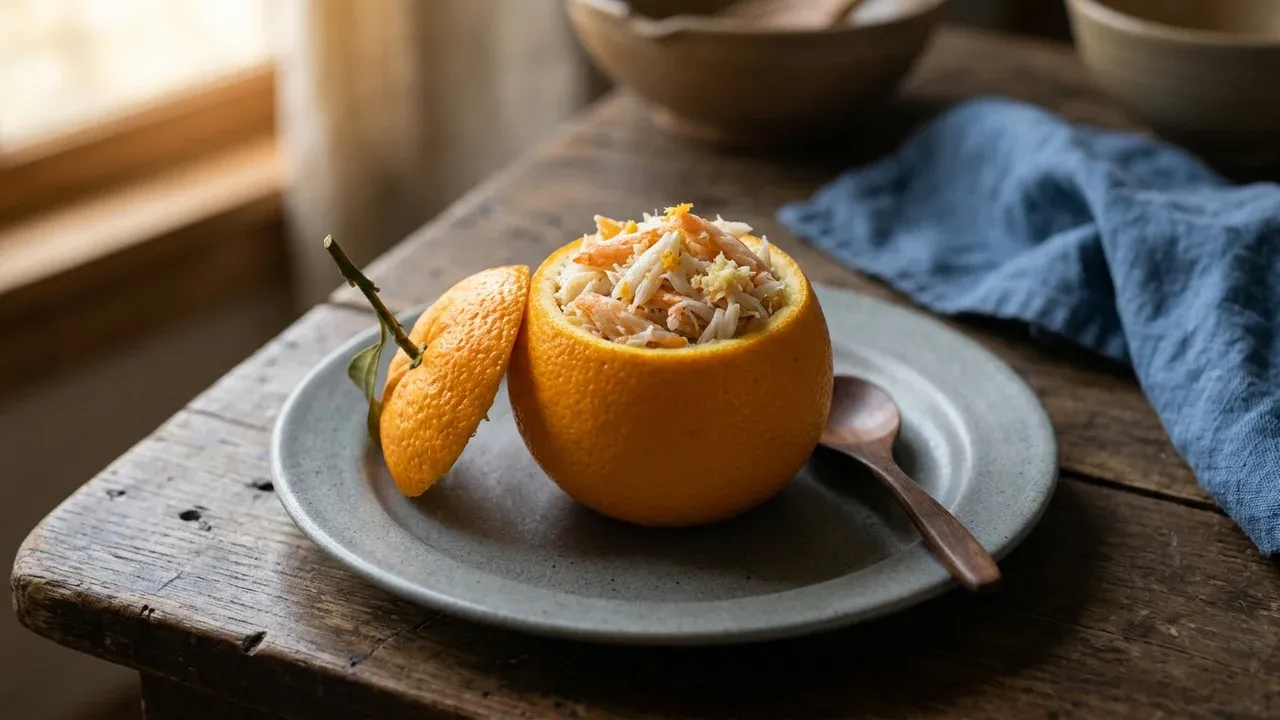
MODERN RECREATION
Modern Adaptation Proposal
Ingredients
Instructions
- Thoroughly wash the outer skins of the oranges under running water with a clean brush, then pat dry. Slice off the top 1/5 to 1/4 horizontally to form a lid. Using a spoon or paring knife, gently scoop out the interior fruit segments without puncturing the rind (approx. 5mm white pith is a guideline; prioritizing not tearing the skin). Squeeze and reserve 15mL (1 tbsp) of juice from the extracted pulp, verify that the bases remain intact, and place the orange bowls on a heatproof plate. [Hygiene note: Keep the fruit bowl vessels clean and undamaged]
- With clean hands, gently flake the pre-cooked crab meat and carefully inspect with your fingertips to remove any remaining shell fragments or cartilage membranes. Store chilled at or below 4°C until assembly. [Hygiene note: Maintain strict hand and utensil hygiene to prevent cross-contamination. Use commercially pasteurized cooked crab meat rather than raw crab]
- In a clean mixing bowl, combine the crab meat, reserved 15mL orange juice, 10mL Shaoxing rice wine, 3g grated ginger (optional), and 1g salt. Gently toss with a spoon to blend without mashing the delicate crab fibers.
- Gently spoon the seasoned crab meat into the two orange bowls, distributing it evenly without packing it too tightly. If fruit capacity is smaller and crab does not fit comfortably, do not force it; steam excess filling in a separate small heatproof cup and check its internal temperature individually. Place the sliced orange tops back onto the fruit as lids.
- Add water (600–800mL reference amount; ensure liquid does not submerge plate), Shaoxing rice wine (30mL), and rice vinegar (15mL) to the steamer pot and bring to a rolling boil (use water only if your appliance prohibits other liquids). Place the heatproof dish holding the stuffed oranges into the steaming tier, cover securely, and steam over medium heat for approximately 12–15 minutes (this duration is a reference guideline, not proof of complete pasteurization). [Burn caution: Steam is extremely hot; use oven mitts when lifting the lid and handling hot vessels]
- Carefully open the steamer lid and insert the probe of a calibrated food thermometer into the thickest center of the crab filling inside each orange (do not touch the citrus peel, base, or plate). Verify that the internal core temperature reaches at least 75°C (167°F) and holds for at least 1 minute as mandated by official health guidelines (U.S. FDA recommends 165°F / 74°C for reheating cooked seafood mixtures). This temperature standard is a safety benchmark, not an empirically verified outcome of this untested formulation. If undercooked, steam for an additional 2–3 minutes and re-test. Never rely solely on visual inspection.
- Carefully remove the heatproof plate using oven mitts (the base of the oranges will be hot). Serve hot with small dishes of rice vinegar (or black vinegar) and sea salt. Diners lift the orange lids, spoon out the fragrant warm crab meat, and season to taste with vinegar and salt. Consume promptly; refrigerate leftovers at or below 4°C within 2 hours (or within 1 hour if ambient temperature exceeds 32°C). [Alcohol caution: Residual alcohol may remain in the filling and steam vapor (residual amount is untested). For children, pregnant or nursing individuals, or alcohol-sensitive diners, substitute water for Shaoxing wine in the filling (10mL) and steamer (30mL), and use plain water in the steamer pot]
HISTORICAL RECORD
Historical Sources and Evidence
These sources provide historical context. They do not necessarily support the quantities or cooking times in the modern adaptation.
Statements supported by sources
The recipe for 'Xie Niang Cheng' (Steamed Crab-Stuffed Orange) is recorded in the upper volume of Lin Hong's 13th-century Southern Song gastronomic treatise 'Shan Jia Qing Gong'. The text was verified using the electronic transcript on Wikisource.
The primary text specifies: 'Select a large orange, cut off the top, scoop out the pulp leaving a little juice, fill the interior with crab meat and rich hepatopancreas/roe, replace the top with its stem attached, place into a small steamer, and steam thoroughly using wine, vinegar, and water; serve with vinegar and salt, filling one with the delights of fresh wine, chrysanthemums, fragrant oranges, and autumn crabs.'
Volume 9 of Zhou Mi's 'Wu Lin Jiu Shi' ('Record of the Royal Visit to General Zhang's Residence') documents the banquet hosted by General Zhang Jun for Emperor Gaozong in the tenth month of 1151 (Shaoxing 21), listing 'Crab-stuffed Orange' (螃蟹釀棖) as the eighth wine accompaniment course. While indicating that a similar elite dish existed well before Lin Hong's book, whether its preparation was identical to Lin Hong's text is historically unconfirmed.
Modern home preparation strictly requires identifying crustacean shellfish allergens, checking labels for wheat allergens in commercial Shaoxing wine and seasonings, using commercially pre-cooked crab meat to eliminate raw crab parasite (Paragonimus) and bacterial risks, inspecting for sharp shell fragments, maintaining cold chain (≤4°C), confirming core internal temperatures of at least 75°C (167°F) held for 1 minute with a food thermometer (noting the FDA 165°F / 74°C reheating reference), preventing cross-contamination, avoiding steam burns, prompt consumption or chilling within 2 hours (1 hour above 32°C), and providing clear non-alcoholic water substitutions.
Inference and interpretation
- In Southern Song Jiangnan culture, autumn was poetically celebrated through the harmony of blooming chrysanthemums, freshly pressed wine, fragrant citrus, and autumn freshwater crabs (such as mitten crabs). The natural acidity and aromatic essential oils of citrus peel were understood to balance the rich sweetness, fats, and potential gaminess of crab meat.
- The historical 'crab meat and butter' (蟹膏肉) refers to both meat and rich internal hepatopancreas/roe of autumn freshwater crabs. The historical 'orange' (橙) was not a modern sweet dessert orange, but rather an indigenous aromatic, thick-skinned, acidic citrus (such as Citrus aurantium or ancestral Citrus sinensis cultivars).
- Lin Hong did not invent this preparation; its prior appearance in the 1151 imperial banquet record in Volume 9 of 'Wu Lin Jiu Shi' indicates it was an aristocratic delicacy of the Southern Song capital Hangzhou (Lin'an) that Lin Hong recorded as an elegant literary dish. It was not everyday peasant food.
Modern adjustments
- To prioritize home safety and availability, this modern adaptation replaces raw freshwater crab and raw roe with commercially pasteurized, pre-cooked 100% crab meat, which constitutes a clear modern safety substitution (strictly requiring cold storage ≤4°C and tactile inspection for shell fragments).
- Modern large sweet oranges (such as Navel oranges, 250–300g) are substituted for historical sour oranges. Because modern oranges are sweeter and less acidic, fruit juice is limited to 1 tablespoon (15mL) and balanced with an optional touch of fresh ginger (3g) and vinegar.
- Shaoxing rice wine and rice vinegar are added to the steamer water as a modern desktop adaptation of 'steamed with wine, vinegar, and water', subject to appliance instructions, accompanied by an explicit internal core temperature measurement of at least 75°C (167°F) held for at least 1 minute.
- Reflecting the primary instruction 'serve with vinegar and salt', small condiment dishes of rice vinegar and sea salt are provided at the table for individual seasoning.
- Clear crustacean and potential seasoning wheat allergen warnings are mandated, steam burn precautions are specified, prompt chilling rules are emphasized, and a complete non-alcoholic alternative (replacing wine with water in filling and steamer) is provided for sensitive diners.
Sources and references
- 『山家清供』巻上「蟹釀橙」Open source: https://zh.wikisource.org/wiki/山家清供
Consulted the entry 'Xie Niang Cheng' (Crab-Stuffed Orange) in the upper volume of Lin Hong's Southern Song gastronomic book 'Shan Jia Qing Gong' (c. 13th century). The primary text states: 'Select a large orange, cut off the top, scoop out the pulp leaving a little juice, fill the interior with crab meat and rich hepatopancreas/roe, replace the top with its stem attached, place into a small steamer, and steam thoroughly using wine, vinegar, and water; serve with vinegar and salt...' Consulted the electronic text on Wikisource alongside variant readings from the 'Shuo Fu' and 'Siku Quanshu' traditions (such as 'select a ripe yellow large orange' and 'serve with vinegar and salt'). Direct physical examination of Song-era original prints or manuscripts was not performed.
- 『武林舊事』巻九「高宗幸張府節次略」Open source: https://zh.wikisource.org/wiki/武林舊事/卷九
Consulted Volume 9 of Zhou Mi's late Song / early Yuan chronicle 'Wu Lin Jiu Shi', specifically the record 'Gaozong Xing Zhang Fu Jie Ci Lue' for the grand banquet hosted by General Zhang Jun for Emperor Gaozong in the tenth month of 1151 (Shaoxing 21). The eighth course of wine accompaniments lists 'Crab-stuffed Orange' (螃蟹釀棖), providing evidence that a similar elite delicacy was served among Southern Song aristocratic circles nearly a century prior to Lin Hong's book, although whether its preparation was identical to Lin Hong's recipe is unconfirmed. Consulted the Wikisource electronic text (Volume 9); original manuscripts were not directly examined.
- 厚生労働省「家庭でできる食中毒予防の6つのポイント」Open source: https://www.mhlw.go.jp/topics/syokuchu/dl/point.pdf
Consulted for official food safety guidelines regarding crustacean and stuffed steamed dishes: ensuring internal core temperature reaches at least 75°C (167°F) and is held for at least 1 minute, sanitizing hands and utensils, preventing cross-contamination, and prompt consumption or refrigeration.
- FDA「Selecting and Serving Fresh and Frozen Seafood Safely」Open source: https://www.fda.gov/food/buy-store-serve-safe-food/selecting-and-serving-fresh-and-frozen-seafood-safely
Consulted for official seafood safety guidelines: selecting commercially prepared seafood, recognizing crustacean allergen risks, inspecting for shell fragments, and noting the FDA's reference recommendation of 165°F (74°C) for reheating cooked seafood mixtures.
Image credits and sources
© History Meshi (AI-generated recreation image / AIによる再現イメージ)
Source: Modern adaptation concept based on Lin Hong's Shan Jia Qing Gong (13th c.) and the 1151 banquet record in Zhou Mi's Wu Lin Jiu Shi / 林洪『山家清供』(13世紀)および周密『武林舊事』(1151年御宴記録)に基づく再現イメージ
License: Original site asset (not an actual cooking or historical source photograph / 実際の調理・史料写真ではありません)