4th Century BCE (Classical Greece)
Ancient Greek Grilled Tuna
A historically inspired recreation based on the 4th-century BCE culinary poet Archestratus's 'Hedypatheia' (preserved in Athenaeus's 'Deipnosophistae'). Beyond the strict historical prohibition of vinegar, this untested modern home recreation proposal opts to omit lemon and heavy sauces entirely, broiling prime tuna simply with a touch of salt and olive oil to celebrate the natural flavor of the fish.
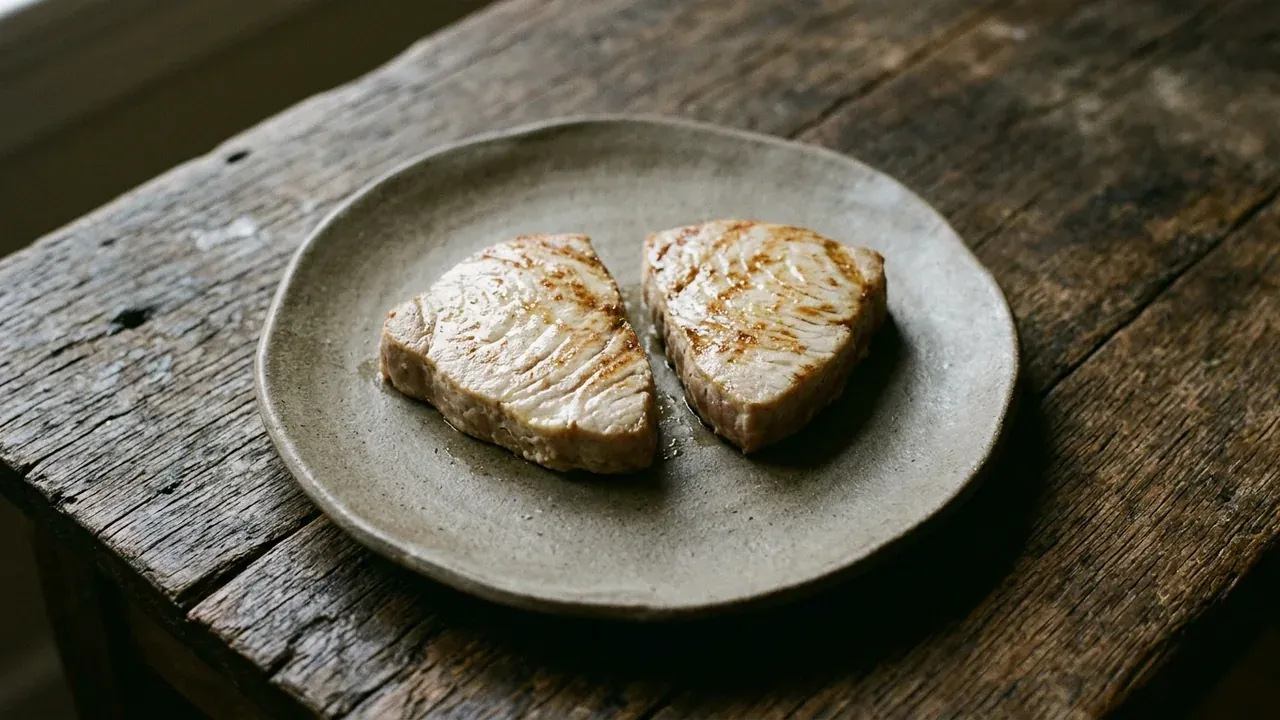
MODERN RECREATION
Modern Adaptation Proposal
Ingredients
Instructions
- Prepare hygienically refrigerated tuna steaks, gently blotting any surface moisture with clean paper towels. If using frozen tuna, thaw slowly inside the refrigerator and never at room temperature.
- Sprinkle 1.2g of salt evenly over both sides of the tuna steaks.
- Heat 4g of olive oil in a skillet over medium heat. Place the tuna steaks in the pan and sear for approx. 2–3 minutes until lightly browned, then flip and cook the other side over medium-low heat for another 2–3 minutes (times are untested guidelines and do not guarantee doneness; beware of oil splatters and scorching).
- Use a clean food probe thermometer to verify that the internal core temperature at the thickest part reaches at least 75°C (167°F) for 1 minute (cook further if below target). Checking that the flesh is opaque and flakes easily serves only as an auxiliary visual sign, not a substitute for temperature measurement.
- Drizzle the remaining 2g of olive oil over the surface and serve immediately while hot, choosing as a modern adaptation not to add vinegar or lemon in honor of the fish's pure taste.
HISTORICAL RECORD
Historical Sources and Evidence
These sources provide historical context. They do not necessarily support the quantities or cooking times in the modern adaptation.
Statements supported by sources
In his gastronomic poem 'Hedypatheia' (quoted in Athenaeus, Deipnosophistae 7.301e–302b), Archestratus of Gela instructs taking a tail cut of a large female tunny at Byzantium.
The poem prescribes broiling the slices properly with a little salt while basting with oil, and eating them hot either plain or dipped in pungent brine.
Archestratus explicitly warns that splashing vinegar utterly ruins the dish.
Inference and interpretation
- The 'large female tunny' in the poem is generally interpreted as referring to mature Atlantic bluefin tuna (*Thunnus thynnus*) migrating through the Mediterranean and Black Sea, though exact modern biological species identification cannot be established from the poetic text alone. The tail cut is understood as firm, well-exercised muscle.
- The oil is understood to be olive oil, the dominant culinary fat of classical Greece, and the heating method is interpreted as charcoal grilling or broiling.
- Archestratus specifically condemned vinegar; this did not mean citrus or sauces were universally forbidden in antiquity. In this modern home adaptation, omitting lemon and sauces is an interpretive choice to highlight the unadorned flavor of the fish.
- This represents ancient Greek-speaking culinary culture and must not be identified as a modern Greek national dish.
Modern adjustments
- Designed as an untested modern home adaptation using commercially available tuna steaks (bluefin, yellowfin, or bigeye) totaling 240g (two 120g steaks, ~2 cm thick), 6g olive oil, and 1.2g salt, cooked in a standard kitchen frying pan.
- Established an essential safety step requiring verification of an internal core temperature of at least 75°C (167°F) for 1 minute with a probe thermometer (flaking flesh is an auxiliary visual check).
- All measurements and cooking times are untested modern guidelines.
Sources and references
- Athenaeus: Deipnosophistae, Book VII (Archestratus, Hedypatheia)Open source: https://penelope.uchicago.edu/Thayer/e/roman/texts/athenaeus/7d%2A.html#301e
Consulted the fragments of the 4th-century BCE poet Archestratus of Gela from his 'Hedypatheia' (Life of Luxury), preserved as quotations in Athenaeus's 'Deipnosophistae', Book VII (301e–302b, Loeb Classical Library translation by C. B. Gulick). The passage directs taking a tail slice of a large female tunny at Byzantium, broiling it properly with a little salt while basting with oil, and eating it hot either dipped in pungent brine or plain, while strictly warning that sprinkling vinegar utterly ruins the dish. Archestratus's original poem is lost and is preserved only through quotations in Athenaeus; this article references the published English translation, and ancient Greek manuscripts were not directly inspected.
- 厚生労働省「これからママになるあなたへ お魚について知ってほしいこと」(魚介類に含まれる水銀について)Open source: https://www.mhlw.go.jp/topics/syokuchu/051105-1.html
Consulted for official Japanese guidance on mercury in predatory fish (tuna species) for pregnant women and women who may be pregnant: based on a standard serving of about 80g, specific intake guidelines by species (Pacific bluefin and bigeye tuna limited to about 80g once a week; southern bluefin limited to about 80g twice a week; yellowfin, albacore, and canned tuna require no special intake restriction).
- FDA「Scombrotoxin (Histamine-forming) Fish and Fishery Products」GuidanceOpen source: https://www.fda.gov/food/guidance-documents-regulatory-information-topic-food-and-dietary-supplements/fishery-products-guidance
Consulted for official FDA safety guidance on scombrotoxin (histamine) fish poisoning: emphasizing that histamine once formed is heat-stable and cannot be destroyed by normal cooking, requiring strict cold-chain management (at or below 4°C/40°F) and avoiding room-temperature standing.
- 厚生労働省「家庭でできる食中毒予防の6つのポイント」Open source: https://www.mhlw.go.jp/topics/syokuchu/dl/point.pdf
Consulted for official food safety guidance regarding cooking temperatures (core temperature of 75°C for at least 1 minute) and kitchen hygiene: cleaning and sanitizing utensils and hands after handling raw fish, preventing cross-contamination, prompt consumption, and refrigerating leftovers.
Image credits and sources
© History Meshi (AI-generated recreation image / AIによる再現イメージ)
Source: Modern adaptation concept based on Archestratus's Hedypatheia in Athenaeus's Deipnosophistae / アルケストラトス『生活の快楽』(アテナイオス『食卓の賢人たち』所収)に基づく再現イメージ
License: Original site asset (not an actual cooking or historical source photograph / 実際の調理・史料写真ではありません)